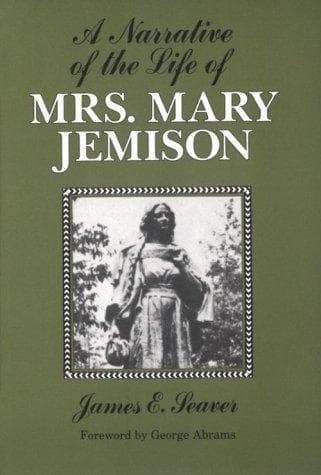
A Narrative of the Life of Mrs. Mary JemisonSeaver, James E. (James Everett)
History
A Narrative of the Life of Mrs. Mary Jemison
Seaver, James E. (James Everett)
Jemison, Mary, 1743-1833; Seneca Indians
When the Council was opened, and the business afforded a proper
opportunity, Farmer's Brother presented my claim, and rehearsed
the request of my brother. Red Jacket, whose Indian name is
Sagu-yu-what-hah, which interpreted, as Keeper-awake, opposed me or my
claim with all his influence and eloquence. Farmer's Brother insisted
upon the necessity, propriety and expediency of his proposition, and got
the land granted. The deed was made and signed, securing to me the
title to all the land I had described; under the same restrictions and
regulations that other Indian lands are subject to.
That land has ever since been known by the name of the Gardow Tract.
Red Jacket not only opposed my claim at the Council, but he withheld my
money two or three years, on the account of my lands having been granted
without his consent. Parrish and Jones at length convinced him that it
was the white people, and not the Indians who had given me the land,
and compelled him to pay over all the money which he had retained on my
account.
My land derived its name, Gardow, from a hill that is within its limits,
which is called in the Seneca language Kau-tam. Kautam when interpreted
signifies up and down, or down and up, and is applied to a hill that you
will ascend and descend in passing it; or to a valley. It has been
said that Gardow was the name of my husband Hiokatoo, and that my land
derived its name from him; that however was a mistake, for the old man
always considered Gardow a nickname, and was uniformly offended when
called by it.
About three hundred acres of my land, when I first saw it, was open
flats, lying on the Genesee River, which it is supposed was cleared by
a race of inhabitants who preceded the first Indian settlements in this
part of the country. The Indians are confident that many parts of this
country were settled and for a number of years occupied by people of
whom their fathers never had any tradition, as they never had seen them.
Whence those people originated, and whither they went, I have never
heard one of our oldest and wisest Indians pretend to guess. When I
first came to Genishau, the bank of Fall Brook had just slid off and
exposed a large number of human bones, which the Indians said were
buried there long before their fathers ever saw the place; and that
they did not know what kind of people they were. It however was and is
believed by our people, that they were not Indians.
Public-domain text, read in full here on John Shaqi.
Reviews
Reviews
No reviews yet
Be the first to share your thoughts on this work.
Join the Discussion
Join the discussion
Sign in to leave a comment or review.
Sign InorCreate an account