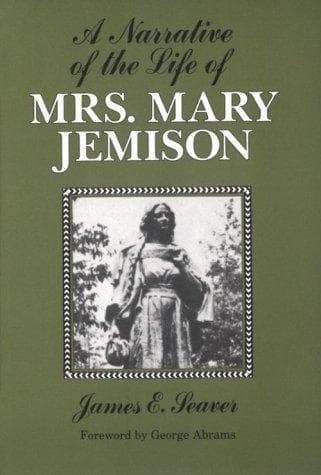
A Narrative of the Life of Mrs. Mary JemisonSeaver, James E. (James Everett)
History
A Narrative of the Life of Mrs. Mary Jemison
Seaver, James E. (James Everett)
Jemison, Mary, 1743-1833; Seneca Indians
My flats were extremely fertile; but needed more labor than my daughters
and myself were able to perform, to produce a sufficient quantity of
grain and other necessary productions of the earth, for the consumption
of our family. The land had lain uncultivated so long that it was
thickly covered with weeds of almost every description. In order that we
might live more easy, Mr. Parrish, with the consent of the chiefs, gave
me liberty to lease or my land to white people to till on shares. I
accordingly let it out, and have continued to do so, which makes my task
less burthensome, while at the same time I am more comfortably supplied
with the means of support.
CHAPTER X.
Happy situation of her Family.--Disagreement between her sons Thomas
and John.--Her Advice to them, &c.--John kills Thomas;--Her
Affliction.--Council. Decision of the Chiefs, &c.--Life of Thomas.--His
Wives, Children; &c.--Cause of his Death, &c.
I have frequently heard it asserted by white people, and can truly say
from my own experience that the time at which parents take the most
satisfaction and comfort with their families is when their children are
young, incapable of providing for their own wants, and are about the
fireside, where they can be daily observed and instructed.
Few mothers, perhaps, have had less trouble with their children during
their minority than myself. In general, my children were friendly to
each other, and it was very seldom that I knew them to have the
least difference or quarrel: so far, indeed, were they from rendering
themselves or me uncomfortable, that I considered myself happy--more so
than commonly falls to the lot of parents, especially to women.
My happiness in this respect, however, was not without alloy; for my son
Thomas, from some cause unknown to me, from the time he was a small lad,
always called his brother John, a witch, which was the cause, as they
grew towards manhood, of frequent and severe quarrels between them, and
gave me much trouble and anxiety for their safety. After Thomas and
John arrived to manhood, in addition to the former charge, John got two
wives, with whom he lived till the time of his death. Although polygamy
was tolerated in our tribe, Thomas considered it a violation of good
and wholesome rules in society, and tending directly to destroy that
friendly social intercourse and love, that ought to be the happy result
of matrimony and chastity. Consequently, he frequently reprimanded
John, by telling him that his conduct was beneath the dignity,
and inconsistent with the principles of good Indians; indecent and
unbecoming a gentleman; and, as he never could reconcile himself to it,
he was frequently, almost constantly, when they were together, talking
to him on the same subject. John always resented such reprimand, and
reproof, with a great degree of passion, though they never quarrelled,
unless Thomas was intoxicated.
Public-domain text, read in full here on John Shaqi.
Reviews
Reviews
No reviews yet
Be the first to share your thoughts on this work.
Join the Discussion
Join the discussion
Sign in to leave a comment or review.
Sign InorCreate an account