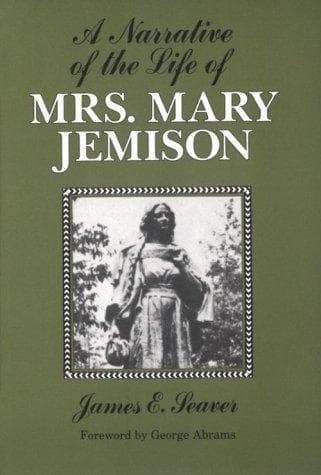
A Narrative of the Life of Mrs. Mary JemisonSeaver, James E. (James Everett)
History
A Narrative of the Life of Mrs. Mary Jemison
Seaver, James E. (James Everett)
Jemison, Mary, 1743-1833; Seneca Indians
The account that he gives is as follows:--In July, 1759, the British,
under Sir William Johnston, took possession of Forts Niagara and
Sclusser, which had before been in the hands of the French. At this
time, the Seneca Indians, (which were a numerous and powerful nation,)
were hostile to the British, and warmly allied to the French. These
two posts, (viz.) Niagara and Sclusser, were of great importance to the
British, on the account of affording the means of communication with the
posts above, or on the upper lakes. In 1760, a contract was made between
Sir William Johnston and a Mr. Stedman, to construct a portage road from
Queenston landing to Fort Sclusser, a distance of eight miles, in order
to facilitate the transportation of provision, ammunition, &c. from
one place to the other. In conformity to this agreement, on the 20th of
June, 1763, Stedman had completed his road, and appeared at Queenston
Landing, (now Lewiston,) with twenty-five portage wagons, and one
hundred horses and oxen, to transport to Fort Sclusser the king's
stores.
At this time Sir William Johnston was suspicious of the intentions of
the Senecas; for after the surrender of the forts by the French, they
had appeared uneasy and hostile. In order to prevent the teams, drivers
and goods, receiving injury, he detached 300 troops to guard them
across the portage. The teams, under this escort, started from Queenston
landing--Stedman, who had the charge of the whole, was on horse back,
and rode between the troops and teams; all the troops being in front.
On a small hill near the Devil's Hole, at that time, was a redoubt
of twelve men, which served as a kind of guard on ordinary occasions,
against the depredations of the savages. "On the arrival of the troops
and teams at the Devil's Hole," says a manuscript in the hands of my
informant, "the sachems, chiefs and warriors of the Seneca Indians,
sallied from the adjoining woods, by thousands, (where they had been
concealed for some time before, for that nefarious purpose,) and falling
upon the troops, teams and drivers, and the guard of twelve men before
mentioned, they killed all the men but three on the spot, or by driving
them, together with the teams, down the precipice, which was about
seventy or eighty feet! The Indians seized Stedman's horse by the
bridle, while he was on him, designing, no doubt, to make his sufferings
more lasting than that of his companions: but while the bloody scene was
acting, the attention of the Indian who held the horse of Stedman being
arrested, he cut the reins of his bridle--clapped spurs to his horse,
and rode over the dead and dying, into the adjacent woods, without
receiving injury from the enemy's firing. Thus he escaped; and besides
him two others--one a drummer, who fell among the trees, was caught by
his drum strap, and escaped unhurt; the other, one who fell down the
precipice and broke his thigh, but crawled to the landing or garrison
Public-domain text, read in full here on John Shaqi.
Reviews
Reviews
No reviews yet
Be the first to share your thoughts on this work.
Elsewhere in the archive
Join the Discussion
Join the discussion
Sign in to leave a comment or review.
Sign InorCreate an account