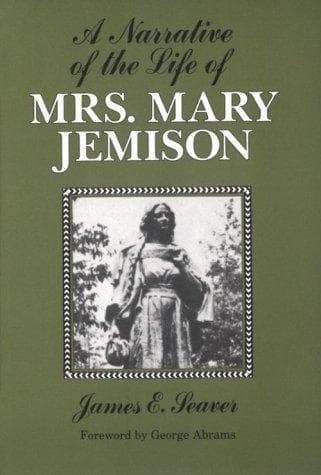
A Narrative of the Life of Mrs. Mary JemisonSeaver, James E. (James Everett)
History
A Narrative of the Life of Mrs. Mary Jemison
Seaver, James E. (James Everett)
Jemison, Mary, 1743-1833; Seneca Indians
That part of the army under Gen. Sullivan, had, on their arrival at
Tioga Point, found the Indians in some force there, with whom they had
had some unimportant skirmishes before our arrival. Upon the junction
of these two bodies of troops, Gen. Sullivan assumed the command of the
whole, and proceeded up the Tioga. When within a few miles of the place
now called Newtown, we were met by a body of Indians, and a number of
troops well known in those times by the name of Butler's Rangers, who
had thrown up, hastily, a breastwork of logs, trees, &c. They were,
however, easily driven from their works, with considerable loss on their
part, and without any injury to our troops. The enemy fled with so
much precipitation, that they left behind them some stores and camp
equippage. They retreated but a short distance before they made a stand,
and built another breastwork of considerable length, in the woods, near
a small opening. Sullivan was soon apprized of their situation, divided
his army, and attempted to surround, by sending one half to the right
and the other to the left, with directions to meet on the opposite
side of the enemies. In order to prevent their retreating, he directed
bomb-shells to be thrown over them, which was done: but on the shells
bursting, the Indians suspected that a powerful army had opened a heavy
fire upon them on that side, and fled with the utmost precipitation
through one wing of the surrounding army. A great number of the enemy
were killed, and our army suffered considerably.
The Indians having, in this manner, escaped, they went up the river to
a place called the Narrows, where they were attacked by our men, who
killed them in great numbers, so that the sides of the rocks next the
river appeared as though blood had been poured on them by pailfulls. The
Indians threw their dead into the river, and escaped the best way they
could.
From Newtown our army went directly to the head of the Seneca lake;
thence down that lake to its mouth, where we found the Indian village at
that place evacuated, except by a single inhabitant--a male child about
seven or eight years of age, who was found asleep in one of the Indian
huts. Its fate I have never ascertained. It was taken into the care of
an officer of the army, who, on account of ill health, was not on duty,
and who took the child with him, as I have since understood, to his
residence on or near the North river.
From the mouth of Seneca lake we proceeded, without the occurrence of
any thing of importance, by the outlets of the Canandaigua, Honeoye, and
Hemlock lakes, to the head of Connissius lake, where the army encamped
on the ground that is now called Henderson's Flats.
Public-domain text, read in full here on John Shaqi.
Reviews
Reviews
No reviews yet
Be the first to share your thoughts on this work.
Elsewhere in the archive
Join the Discussion
Join the discussion
Sign in to leave a comment or review.
Sign InorCreate an account