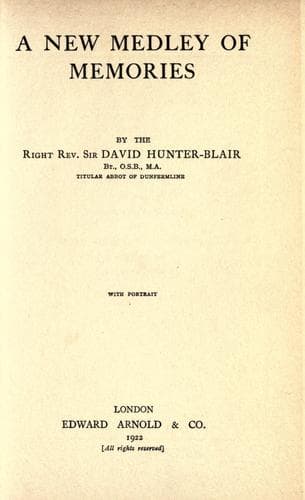
A New Medley of MemoriesHunter Blair, David Oswald, Sir
Religion
A New Medley of Memories
Hunter Blair, David Oswald, Sir
Hunter Blair, David Oswald, Sir, 1853-1939
I was glad to find myself settled for some golden weeks of August and
September at our abbey among {97} the Highland hills, where we were
this autumn favoured with almost continuous sunshine. Our many guests
came and went--some of them busy city men, enjoying to the full the
pure air, lovely surroundings, and quiet life in our guest-house, all
to the accompaniment of chiming bells and chanted psalms. Whether they
found our "brown Gregorians" as devotional as the sentimentalist of Mr.
Hichens's novel[1] I know not; but anyhow to me our monastic
plain-chant was restful and pleasant after the odd stuff in the way of
"church music" which had elsewhere assailed my ears. I confess that
after our more normal Oxford hours (though I hope we were not sluggards
at our Hall), I reconciled myself with difficulty to "the hour of our
uprising" in the monastery. The four o'clock matin-bell had always
been more or less of a penance to me (as I suppose it was to most of my
brethren), though I tried to fortify myself with Dr. Johnson's
argument--a purely academic one in the case of that lie-abed old
sage--that "it is no slight advancement to obtain for so many more
hours the _consciousness of being_"; but an American guest of ours, to
whom I cited this dictum, countered it by a forcibly-expressed opinion
"on the other side" by one of the most eminent living specialists in
insanity.[2]
{98}
One recalls delicious rambles with our brethren or our guests during
those sunlit autumn days: sometimes among the verdant Glengarry woods,
sometimes at our outlying "chapel-of-ease," some miles up the most
beautiful of the glens which run from Central Inverness-shire to the
sea. A veritable oasis this among the hills, with its green meadows,
waving pines, and graceful bridge spanning the rushing river; and all
framing the humble chapel, its eastern wall adorned with a fresco (from
the brush of one of our artist monks[3]) which the little flock--sadly
diminished of late years by emigration--greatly admired and venerated.
A week-end was sometimes spent pleasantly and not unprofitably at some
remote shooting-lodge, saying mass for Catholic tenants, and perhaps a
handful of faithful {99} Highlanders. One such visit I remember this
autumn at a lodge in Glencarron, a wild wind-swept place, with the
surrounding hilltops already snow-coated, which Lord Wimborne (for some
years Lovat's tenant at Beaufort) had recently acquired. Although in
the heart of the forest, the lodge was but two hundred yards from the
railway; there was no station, but the train would obligingly stop when
signalled by the wave of a napkin from the front door! A crofter's cow
strayed on the line one day of my stay, was, by bad luck, run over by
one of the infrequent trains, and (as a newspaper report once said of a
similar mischance) "cut literally into _calves_."[4] The night before
I left Glencarron, we were all wakened, and some of us not a little
Public-domain text, read in full here on John Shaqi.
Reviews
Reviews
No reviews yet
Be the first to share your thoughts on this work.
Elsewhere in the archive
Join the Discussion
Join the discussion
Sign in to leave a comment or review.
Sign InorCreate an account