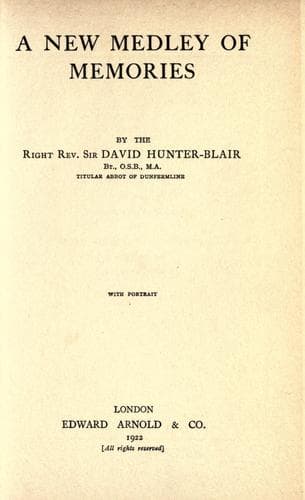
A New Medley of MemoriesHunter Blair, David Oswald, Sir
Religion
A New Medley of Memories
Hunter Blair, David Oswald, Sir
Hunter Blair, David Oswald, Sir, 1853-1939
An excursion or two from Oxford I remember this autumn: one to
Downside, where it was always a happiness to go and spend a
church-festival with my Benedictine brethren; another to Eton, where I
gazed with dismay on the new school-hall with its unsightly dome, and
wondered if this was really the best the Committee of Taste could
achieve by way of South African War Memorial.[9] I met afterwards
quite a contingent of Scotsmen (Arthur Hay, the Duke of Roxburghe's
brother, etc.) at luncheon with the Irish Guards at Victoria Barracks,
where I used to breakfast of a Sunday morning--a dissipation forbidden,
I believe, to modern Etonians--with an uncle in the Scots Fusilier
Guards, in my own school days. I went to London that evening to dine
with, and read afterwards a paper on "Jerusalem of To-day" to, the
Guild of SS. Gregory and Luke, my host being Sir John Knill, Sheriff of
London, who was two years later to occupy the civic chair, as his
excellent father had done before him. On another evening I attended
our Westminster Dining-club, to hear Fr. R. H. Benson read us an essay
on "The Value of Fiction"--interesting, as coming from a successful
novelist, and of course brilliant; but I agreed with only about half of
it.
Ninian Crichton Stuart had engaged me to go and {130} support him at
the St. Andrew's Day banquet of the Caledonian Society of Cardiff, the
suffrages of which city he was at that time wooing as Conservative
candidate, much assisted by his clever and charming wife. I stayed
with them at their pretty home near Llandaff, and we motored in to the
patriotic banquet, which began at 6.30 and lasted nearly five hours! I
proposed the principal toast, and had of course no difficulty in
showing (as one of the newspaper reports remarked) that all the chief
posts in the Empire--political, ecclesiastical, legal and
administrative, were, with the most insignificant exceptions, held by
Scotsmen. Bagpipes, of course, skirled and whisky flowed freely; and
the national enthusiasm reached its height when the haggis was borne
round the hall in procession, carried by the white-clad chef and
preceded by the pipe-major, playing his best and loudest in honour of
the "chief of pudding race." I left Llandaff next morning, Ringan,
Lady Ninian's pretty baby, crowing good-bye to me from his mother's
arms,[10] and spent an hour or two in Cardiff with Bishop Hedley, who
expressed his hope that I would help Kennard at Oxford as long as I
could, and would ultimately succeed him as chaplain. We visited
together the new and splendid town-hall, the finest municipal building
I had ever seen. The Oxford term ended in the following week, {131}
and I made my way north to Fort Augustus, where I found discussion in
progress as whether we should or should not sell our house and estate
of Ardachie, for which we had several good offers. I said yes; for the
place, though not without its attractions, had been altogether more of
Public-domain text, read in full here on John Shaqi.
Reviews
Reviews
No reviews yet
Be the first to share your thoughts on this work.
Elsewhere in the archive
Join the Discussion
Join the discussion
Sign in to leave a comment or review.
Sign InorCreate an account