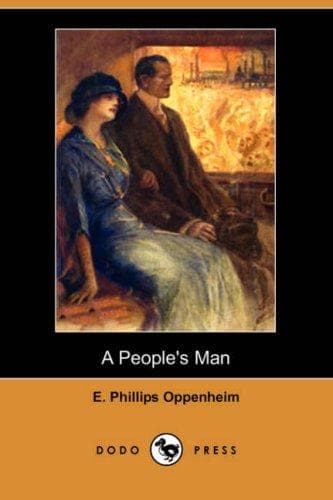
A People's ManOppenheim, E. Phillips (Edward Phillips)
General
A People's Man
Oppenheim, E. Phillips (Edward Phillips)
Detective and mystery stories
"Yes," he admitted slowly, "for some years I did a good many of the
usual things."
"And now the desire for them has all gone," she asked, "haven't you any
personal hopes or dreams in connection with life? Isn't there anything
you look forward to or desire for yourself?"
"I seem to have so little time. And yet, one has dreams--one always
must have dreams, you know."
"Tell me about yours?" she insisted.
He sat up abruptly. Her fingers fell upon his arm.
"We will go and sit under my rose tree," she suggested.
They moved back into the winter garden until they came to a seat at its
furthest extremity. A fountain was playing a few yards away, and
clusters of great pink roses were drooping down from some trellis-work
before them.
"Here, at least," she continued, as she leaned back, "we will not be
tempted to talk seriously. Tell me about yourself? Do you never look
forward into the future? Have you no personal ambitions or hopes?"
He looked steadily ahead of him.
"I am only a very ordinary man," he replied. "Like every one else,
sometimes I look up to the clouds."
"Tell me what you see there?" she begged.
He was silent. The sound of voices now came to them like a distant
murmur, a background to the slow falling of the water into the fountain
basin.
"Lady Elisabeth," he said, "it is not always possible to tell even one's
own self what the thoughts mean which come into one's brain."
"You will not even try to tell me, then?"
"I must not," he answered.
She sat with her hands folded in front of her, her head drooped a
little. Maraton felt himself suddenly at war with a whole multitude of
emotions. Was it possible that this thing had come to him, that a woman
could take the great place in his life, a woman not of his kind, one who
could not even share the passion which was to have absorbed every
impulse of his existence to the end? She was of a different world.
Perhaps it had all been a mistake. Perhaps it would have been better
for him to have stayed outside, to have never crossed the little
borderland which led into the land of compromises. And all the time,
while his brain was at work, something stronger, more wonderful, was
throbbing in his heart. He moved restlessly in his place. Her ungloved
hand lay within a few inches of him. He suddenly caught it.
"Lady Elisabeth," he whispered, "I feel like a traitor. I feel myself
moved to say things to you under false pretences. I ought not to have
come here."
"What do you mean?" she demanded. "You can't mean--"
Their eyes met. He read the truth unerringly. "No, not that," he
answered. "There is no one. What I feel is, at any rate, consecrate.
But I have no right. I am not sure, even at this moment, whether it is
not in my heart to take a step which you would look upon as the blackest
ingratitude. My life, Lady Elisabeth, holds issues in it far apart, and
it is vowed, dedicate."
"You are going to break away?" she asked quietly.
Public-domain text, read in full here on John Shaqi.
Reviews
Reviews
No reviews yet
Be the first to share your thoughts on this work.
Elsewhere in the archive
Join the Discussion
Join the discussion
Sign in to leave a comment or review.
Sign InorCreate an account