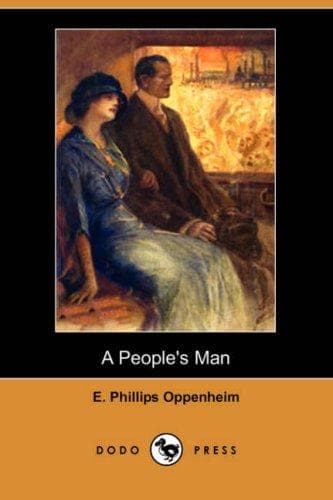
A People's ManOppenheim, E. Phillips (Edward Phillips)
General
A People's Man
Oppenheim, E. Phillips (Edward Phillips)
Detective and mystery stories
"Very well, gentlemen," he said, "let it be war. Perhaps we'd better
let this be the end of our deliberations."
Graveling rose slowly to his feet. His face was filled with evil
things. He pointed to Maraton.
"There's a word more to be spoken!" he exclaimed. "There's more behind
this scheme of Maraton's than he's willing to have us understand! It
looks to me and it sounds to me like a piece of dirty, underhand
business. I'll ask you a question, Maraton. Were you at the Ritz Hotel
one night about two months ago, with the ambassador of a foreign a
country?"
"I was," Maraton admitted coolly.
Graveling looked around with a little cry of triumph.
"It's a plot, this; nothing more nor less than a plot!" he declared
vigorously. "What sort of an Englishman does he call himself, I wonder?
It's the foreigners that are at the bottom of the lot of it! They want
our trade, they'd be glad of our country. They've bribed this man
Maraton to get it without the trouble of fighting for it, even!"
Maraton moved towards the door. Holding it open, he turned and faced
them.
"Before I came," he said, "I hoped that you might be men. I find you
just the usual sort of pigmies. You call yourselves people's men! You
haven't mastered the elementary truths of your religion. What's
England, or France, or any other country in the world, by the side of
humanity? Be off! I'll go my own way. Go yours, and take your little
tinsel of jingoism with you. Whenever you want to fight me, I shall be
ready."
"And fight you we shall," Peter Dale thundered, "mark you that! There's
limits, even to us. The Government of this country mayn't be all it
should be, but, after all, it's our English Government, and there is a
point at which every man has to support it. The law is the law, and so
you may find out, my friend!"
They filed out. Maraton closed the door after them. He was alone. He
threw open the window to get rid of the odour of tobacco smoke which
still hung about. The echo of their raucous voices seemed still in the
air. These were the men who should have been his friends and
associates! These were the men to whom he had the right to look for
sympathy! They treated him like a dangerous lunatic. Their own small
interests, their own small careers were threatened, and they were up in
arms without a moment's hesitation. Not one of them had made the
slightest attempt to see the whole truth. The word "revolution" had
terrified them. The approach of a crisis had driven their thoughts into
one narrow focus: what would it mean for them?
Public-domain text, read in full here on John Shaqi.
Reviews
Reviews
No reviews yet
Be the first to share your thoughts on this work.
Elsewhere in the archive
Join the Discussion
Join the discussion
Sign in to leave a comment or review.
Sign InorCreate an account