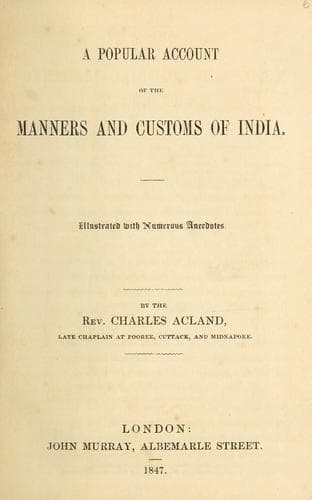
A Popular Account of the Manners and Customs of IndiaAcland, Charles
History
A Popular Account of the Manners and Customs of India
Acland, Charles
India -- Description and travel; India -- Social life and customs
On the Tuesday morning Captain R. was lazy, so I started by myself at
six o'clock to try and get some jungle-fowl. When I say by myself, I
of course mean with three or four servants. I, however, shot nothing
but a few doves and one green pigeon. The latter is a large bird, of
a pale-green colour, and is most delicious eating, which is more than
can be said of any of the game in India. The partridges are dry and
flavourless; the deer have literally not a particle of fat upon them;
the hares are fit for nothing but soup. A leveret is good, and so is
a very young peacock, but, old or young, they must be eaten the same
day that they are killed. By the by, the black partridge is pretty
good: it has a black neck, shading into deep red on the head; the
back is dark; the breast and tail are most beautifully covered with
minute white spots.
I may as well mention now that we shot the other day a double-spurred
partridge; it was of a dingy red colour, with a crest on its head;
the legs were bright red, and each armed with two long sharp spurs.
As I walked along I observed a bird of a species which I had never
seen before; I tried to shoot it, in order to have it stuffed, but
missed, and sadly frightened some monkeys who were in the same tree.
As far as I could judge, every feather was a bright blue, giving a
most splendid appearance to the bird.
[Sidenote: MANGO-BIRD.]
After breakfast Captain R. and I stood at the door of the tent
amusing ourselves with his air-gun. I killed with it three or four
birds, whose skins I should like to preserve; one especially, though
I believe I have before described it, namely, the mango-bird. I
fancy the European name is the golden oriole. It is of one uniform
brilliant yellow, with the exception of the head, which is perfectly
black. Its note is very peculiar, as indeed are the voices of many
of the Indian birds. I cannot describe the sounds on paper, but I
have learned to imitate many of them well enough to hold a long
conversation with them. Once or twice, when Captain R. wanted to
get near to a bird without being observed, he asked me to continue
talking to it. It is curious to observe them hopping from branch to
branch replying to my call, and looking round on every side for the
bird from which they suppose the sound to proceed.
Public-domain text, read in full here on John Shaqi.
Reviews
Reviews
No reviews yet
Be the first to share your thoughts on this work.
Elsewhere in the archive
Join the Discussion
Join the discussion
Sign in to leave a comment or review.
Sign InorCreate an account