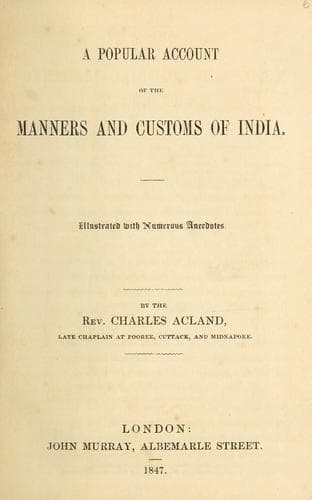
A Popular Account of the Manners and Customs of IndiaAcland, Charles
History
A Popular Account of the Manners and Customs of India
Acland, Charles
India -- Description and travel; India -- Social life and customs
Cuttack, October 13, 1844.
[Sidenote: THE DOCTOR.]
I had to make a five days' journey at the worst season of the year
to marry a couple, and I returned with a bad cough, which became
more violent after the cold had left me. I am very weak, so that I
walk like an old man. The doctors here are paid by the Government
for attending all persons in the service. The Company also find
medicines, but not the bottles, which sometimes leads to curious
circumstances. The other day I wanted some medicine, and sent to the
doctor for it; presently my man brought me back a black-draught in an
old eau-de-cologne bottle, with a roll of paper by way of cork, and a
request that I would return the bottle, as it was the only one he had.
I am about to apply for leave of absence. I shall go up to Calcutta,
spend a fortnight with my friends there, Mr. and Mrs. S.; they will
then come down here, when Mrs. Acland will join us, and we shall go
to the Chelka Lake and the black pagodas.
I have another monkey now, which is kept at the stable; it is a
horrible animal, about a foot and a half high, of a light greenish
brown colour, no hair on its head, and very much inclined to be
savage. I keep it to please my stable-people, who have a superstition
that this kind of monkey prevents the horses getting unwell. Not long
ago a young officer turned a very savage one loose; it took up its
abode in my compound. In one night it killed three of my fan-tailed
pigeons, and it chased my goats backward and forward so incessantly,
that one of them died of fatigue. I told my stable-people to catch
the animal, and get rid of him. This they did not do; so I then gave
them notice, that, if the monkey was not in the jungle on the other
side of the river by seven o'clock the next morning, I would cut them
all a month's pay. This is the best method of punishing the natives,
and in the present instance it was most effectual, for I have not
seen the fiendish-looking face of the exile since that day.
In India the cow's milk is very bad, poor, and thin; that of the
buffalo is of a bad colour and rank; but what is furnished by the
goat is delicious, and many people, ourselves among the number, keep
flocks of goats. I flatter myself that mine (twelve goats and seven
kids) are very handsome. The male kids we eat when they are old
enough to leave their mother; they are very nice indeed. Our goats
are much larger than those in England, but all other animals are
very small. I have heard it said at table, "Will you take a shoulder
or leg of lamb?" Beef and veal in this bigoted part of the country
are quite forbidden things. Yet how curious this is! No animals are
worse treated than the bullocks, which are here the only beasts of
burden. They are starved and ill-used in every way. I have seen a man
dislocate several joints successively of his bullock's tail; yet, if
I were to fire my gun at the poor animal to put it out of its misery,
I should probably have my house burnt over my head.
Public-domain text, read in full here on John Shaqi.
Reviews
Reviews
No reviews yet
Be the first to share your thoughts on this work.
Elsewhere in the archive
Join the Discussion
Join the discussion
Sign in to leave a comment or review.
Sign InorCreate an account