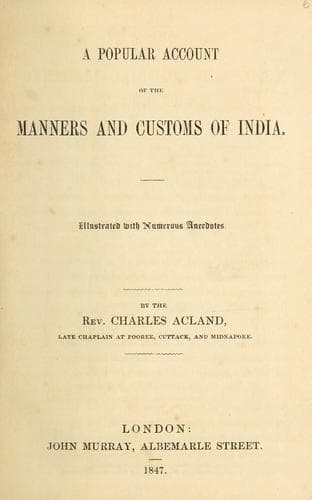
A Popular Account of the Manners and Customs of IndiaAcland, Charles
History
A Popular Account of the Manners and Customs of India
Acland, Charles
India -- Description and travel; India -- Social life and customs
"Choop ruho!" (keep quiet) I called out, but to no effect. "Choop
ruho!" I bawled, but still to no avail; I could not hear what Mrs.
L. said. Suddenly I snatched the stick out of the hand of the man
next me, just gave it a little flourish, and jumped into the middle
of the crowd. "You want the whip, eh?" I shouted. "Choop ruho, will
you?" (for a word or two of English generally slips in either at
the beginning or the end of a hasty sentence). In one instant there
was a dead silence: not a word of resistance, or even insolence.
Mrs. L. was weak and faint, and it seemed she wanted a glass of
wine-and-water; this detained us a little time, but as long as we
remained there I found that, even if a whisper arose, the single
word "Choop" was sufficient to quiet it directly.
Now, some people may say, here is a long story about nothing, or
rather about getting a glass of wine-and-water; but I wish you
to observe everything that takes place. Now, the nullah and the
jungles, and the torches and the palanquins, are no great wonders
in themselves, but together they make a pretty picture, or rather a
striking one; and so through life you will find that every half-dozen
things that you observe will either form, or assist in forming, some
picture in your minds, which will certainly prove amusing or useful,
or both.
Then, again, suppose I had told you that I desired the men to be
quiet, and they obeyed me: that would have been much shorter, but it
would not have led the mind on to any other train of thought; whereas
the narrative, as I have related it, suggests many ideas which, if
followed up, would fill whole pages; for instance--
1st. Why did the men dread the whip, when they were equally well
armed?
2nd. Are they accustomed to feel it?
3rd. Are they generally oppressed, and in what way; and would a
native government be an advantage to them?
4th. In what does that superiority consist which makes one hundred
Hindus afraid of one European?
5th. What is civilization? What is the difference between _real_
civilization, and that knowledge of arts and sciences, of
railroads and balloons, which is commonly dignified with the name?
And also what is the connexion between real, true civilization and
religion?
Here are a few out of numberless trains of thought and questions
which might arise, and do naturally arise, from the little anecdote
I have given. Now, suppose I had said, "At one stage Mrs. L. said
something to me which I could not well make out on account of the
noise the men made; however, I soon quieted them, and then found that
she wanted some wine-and-water." That description would have given no
idea of what actually took place, neither would it have afforded any
subject for after consideration.
Public-domain text, read in full here on John Shaqi.
Reviews
Reviews
No reviews yet
Be the first to share your thoughts on this work.
Elsewhere in the archive
Join the Discussion
Join the discussion
Sign in to leave a comment or review.
Sign InorCreate an account