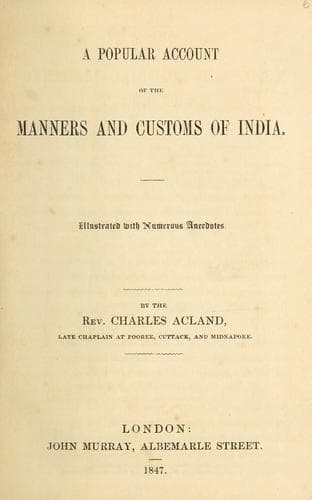
A Popular Account of the Manners and Customs of IndiaAcland, Charles
History
A Popular Account of the Manners and Customs of India
Acland, Charles
India -- Description and travel; India -- Social life and customs
I believe every one in Bengal keeps more servants than I do. In the
Madras presidency not nearly so many are required, as one there
will do the work of three here. I do not know how it is in Bombay.
I suppose it is on this account that in the Bengal presidency we
receive higher pay than in the other parts of India. I said that I
kept fewer than most people, but I certainly think I am better served
than those who keep double the number, and I attribute it to this: I
never beat my servants; I scold them, but do not strike them: and I
believe that they exert themselves very much in order that they may
remain with me on that account, for the cruelty practised by many
towards their domestics is most shocking. Yet I firmly believe that I
am better served, and, if I may use the expression, really loved, for
that very reason.
When a servant is ill it is usual to stop his wages entirely: this
I think wrong, and I therefore only stop half, which is another
inducement to them to exert themselves in order to remain with me. I
will give an instance of the sort of exertion to which I allude. When
I packed the last box for England, my carpenter was ill; my cook is a
very handy sort of man, so I called him, and desired him to nail up
the box; he did it without a moment's hesitation. Almost any other
cook would rather have left his situation than have done what he did
not consider his work.
Again, I do not know any other person who can get one man to wait on
both the sahib and the mem. My khitmutgar not only does this, but
also cleans my gun, and sometimes goes out shooting with me; when he
is thus engaged the cook supplies his place. These are the advantages
of kindness.
It is a common saying that the Hindus have no sense of gratitude,
that they have not even a word to express that feeling in their
language. I do not believe it, and will give you a case in point.
When we are going to travel we pay the money for the bearers into the
hands of the postmasters beforehand; he then orders the men to be
ready at each stage, and he subsequently sends them their pay. At one
stage, as I was going to Midnapore some time ago, the men complained
to me that they had not received their money for many months. I
questioned them, and, finding their story probable, I promised to
speak to the postmaster, and also offered to carry a petition from
them to him. This I did; there had been a fault somewhere, but not, I
believe, with the postmaster. However, the poor men got their money.
Since that time, whenever I go along the road, as soon as I come to
that place a man calls out, "Here is the kind sahib that took our
letter for us;" and although the stage is ten miles in length, yet
they carry me over it in less time than it takes me to go a six-mile
stage elsewhere. My palkee is a heavy one, but they literally run as
fast as they can the whole way; and two additional men always go with
them without asking for any pay. Is not this something like gratitude?
Public-domain text, read in full here on John Shaqi.
Reviews
Reviews
No reviews yet
Be the first to share your thoughts on this work.
Elsewhere in the archive
Join the Discussion
Join the discussion
Sign in to leave a comment or review.
Sign InorCreate an account