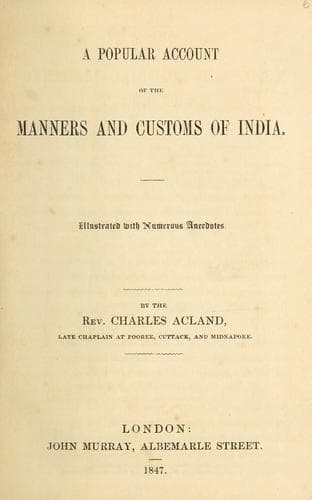
A Popular Account of the Manners and Customs of IndiaAcland, Charles
History
A Popular Account of the Manners and Customs of India
Acland, Charles
India -- Description and travel; India -- Social life and customs
But one thing struck me especially, and it is a thing highly to the
credit of our Indian Government. Pointing to his retinue, he said,
"This I very much admire. In my own country and all the native states
(that is, states governed by native rajahs), if I were to go to
sleep, I must set my guards round me with their arms in their hands,
and I dare not ask a stranger to carry a thing for me lest he should
run away with it. But directly I come into the Burra Beebee Company's
territories" (the East India Company is called the Burra Beebee, or
the great lady, by all the natives), "directly I come into their
territories, although they are so vast, so immense, from sea to sea"
(and he stretched forth his hands in every direction), "directly I
come there, if I am weary, I can go to sleep under any tree by the
roadside, and I can tell all my guards to go to sleep also. If I want
anything carried, I can say to the stranger 'Carry it,' and I know it
is safe. Oh! the Burra Beebee Company is a very good great king."
And most assuredly it is so. Wherever we come we give sound laws, and
the people find peace and comparative happiness. Under the native
rajahs all is anarchy, bloodshed, and oppression. Would that the
whole of India were under our sway, and that our Government would
seek, by firm and decisive measures, to introduce the blessings of
Christianity amongst the thousands and millions of their heathen
subjects! I consider these few words of Bheere Singh to confer far
more real honour on our Government than all their victories.
[Sidenote: A MEETING.]
How little one knows in England of the pleasure of meeting with an
acquaintance! The other night, as I was travelling and just dozing in
my palanquin, I was roused by a loud voice--"Hulloh, Acland! what,
is that you?" I was out of my palkee in an instant, and Mr. C., of
Talacore, jumped out of his. What a break in the monotony of the
road! and yet there was one great unpleasantness about it, and that
was, we were obliged, after a few minutes' gossip, each to return to
his own solitary palanquin. He produced some oranges; we sucked one
or two, and then separated.
FOOTNOTE:
[5] This man continued most faithfully attached till his master's
death, and was then inconsolable.
Cuttack, December 25, 1843.
Yesterday morning Captain W. sent to ask me whether I would go out
into the jungle with him and try and get some hares. I did not feel
much inclined, as my yearly supply of stores, such as wine, beer,
candles, vinegar, &c. &c., had just arrived from Calcutta. However I
thought that perhaps I should see something which might amuse me, so
I went. At three we started on our ponies across the tedious sands
to the river. The water we crossed in a boat, and then remounted and
rode for some distance into the jungle: at last down we got. We had
fourteen men with us to beat the jungle.
[Sidenote: CHOUDWAR.]
Public-domain text, read in full here on John Shaqi.
Reviews
Reviews
No reviews yet
Be the first to share your thoughts on this work.
Elsewhere in the archive
Join the Discussion
Join the discussion
Sign in to leave a comment or review.
Sign InorCreate an account