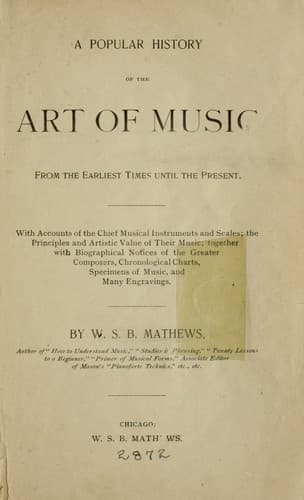
A Popular History of the Art of Music: From the Earliest Times Until the PresentMathews, W. S. B. (William Smythe Babcock)
History
A Popular History of the Art of Music: From the Earliest Times Until the Present
Mathews, W. S. B. (William Smythe Babcock)
Music -- History and criticism
Accordingly we find him in Italy, in 1710, first at Naples, where he
made the acquaintance of the greatest harpsichord player of that time,
Domenico Scarlatti. The style of the young German was so charming, and
so different from that of the great Italian player, that he
immediately became a favorite, and was called _Il Caro Sassone_ ("The
dear Saxon"). He produced an opera in Naples with good success.
Afterward he produced others at Rome and Venice. In a few years he was
back at Hanover, where he was made musical director to the Elector
George, who afterward became George I of England. Here, presently, he
took a vacation in order to visit London, where he found things so
much to his liking that he remained, having good employment under
Queen Anne, and a public anxious to hear his Italian operas. Presently
Queen Anne died and George the First came over to reign as king. This
was altogether a different matter, for Haendel had his unsettled
account with the elector of Hanover, upon whom he had so cavalierly
turned his back. The peace was finally made, however, by a set of
compositions very celebrated in England under the name of "The Water
Music." When King George was going from Whitehall to Westminster in
his barge, Haendel followed with a company of musicians, playing a
succession of pieces, which the king knew well enough for a production
of his truant capellmeister. Accordingly he received him once more
into favor, and Haendel went on with his work.
For upwards of twenty years, Haendel pursued his course in London as a
composer of Italian operas, of which the number reached about forty.
During the greater part of his time he had his own theater, and
employed the singers from Italy and elsewhere, producing his works in
the best manner of his time. His operas were somewhat conventional in
their treatment, but every one of them contained good points. Here and
there a chorus, occasionally a recitative, now and then an
aria--always something to repay a careful hearing, and occasionally a
master effect, such as only genius of the first order could produce.
His education during this period was exactly opposite to that of Bach.
Bach lived in Leipsic all his life, and, being in a position from
which only a decided fault of his own could discharge him, he
consulted no one's taste but his own, writing his music from within,
and adapting it to his forces in hand, or not adapting it, as it
pleased him. Haendel, on the other hand, had always the public. He
commenced as an operatic composer. As an operatic composer he
succeeded in Hamburg, and as an operatic composer he succeeded in
Italy. The same career held him in London. There was always an
audience to be moved, to be affected, to be pleased, and there were
always singers of high talents to carry out his conceptions. Hence his
whole training was in the direction of smoothness, facility, pleasing
quality. Nevertheless, there came an end to the popularity of Haendel.
Public-domain text, read in full here on John Shaqi.
Reviews
Reviews
No reviews yet
Be the first to share your thoughts on this work.
Elsewhere in the archive
Join the Discussion
Join the discussion
Sign in to leave a comment or review.
Sign InorCreate an account