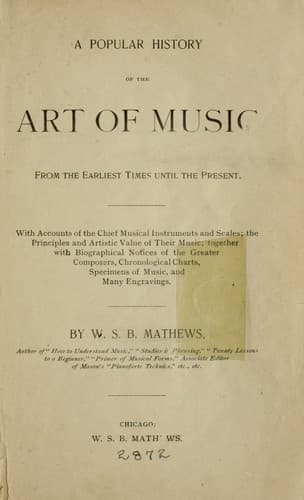
A Popular History of the Art of Music: From the Earliest Times Until the PresentMathews, W. S. B. (William Smythe Babcock)
History
A Popular History of the Art of Music: From the Earliest Times Until the Present
Mathews, W. S. B. (William Smythe Babcock)
Music -- History and criticism
Haendel was never married; nor, so far as we know, ever in love. He had
among his friends some of the most eminent writers of his day, such as
Addison, Pope, Dean Swift and others. His later years were so
successful that when he died his fortune of above L50,000 was left for
charitable purposes. This was after he had paid all of the
indebtedness incurred in his earlier bankruptcy. It would be a mistake
to dismiss this great master without some notice of his harpsichord
and organ playing. As a teacher of the princesses of the royal family,
he produced many suites and lessons for the harpsichord, in one of
which, as an unnoticed incident, occur the air and variations since so
universally popular under the name of "The Harmonious Blacksmith." It
is not known to whom the composer was indebted for the name generally
applied to this extremely broad air, and clever variations. Very
likely some music publisher was the unknown poet. As an organist
Haendel was both great and popular. In the middle of his oratorios he
used to play an organ concerto with orchestra. Of these compositions
he wrote a very large number. They are always fresh and hearty in
style, well written for organ, and with a very flowing pedal part.
Haendel appears to have played the pedals upon a somewhat different
plan from that of Bach. Bach is generally supposed to have used his
toes for the most part, employing the heel only for an occasional note
where the toes were insufficient. Haendel seems to have used toe and
heel habitually in almost equal proportion.
It is a curious feature of the later part of Haendel's career that he
brought out his oratorios in costume. Several of the original bills
are extant, in which an oratorio is promised "with new cloathes."
"Esther" is said to have been given with complete stage appointment at
Chandos, like an opera; but the Lord Chamberlain prohibited future
representations of the kind on account of the supposed sacredness of
the subject. Afterward the characters were costumed, and the stage
set, but there was no action. While Haendel was German by birth, his
long residence in England and his habitual writing for the last ten or
fifteen years of his life oratorios in the English language, made
him, to all intents and purposes, an English composer. For nearly a
century he stood to the English school as a model of everything that
was good and great, to such an extent that very little of original
value was accomplished in that country, and when, by lapse of time and
a deeper self-consciousness on the part of English musicians, this
influence had begun to wane, a new German composer came in the person
of Felix Mendelssohn Bartholdy, who, in turn, became a popular idol,
and for many years a barrier to original effort.
Public-domain text, read in full here on John Shaqi.
Reviews
Reviews
No reviews yet
Be the first to share your thoughts on this work.
Elsewhere in the archive
Join the Discussion
Join the discussion
Sign in to leave a comment or review.
Sign InorCreate an account