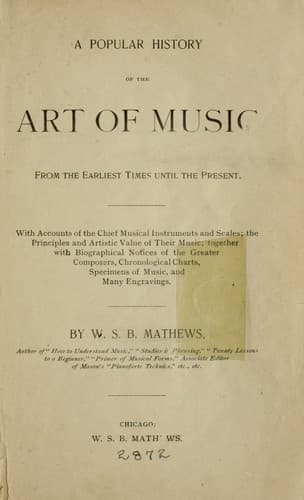
A Popular History of the Art of Music: From the Earliest Times Until the PresentMathews, W. S. B. (William Smythe Babcock)
History
A Popular History of the Art of Music: From the Earliest Times Until the Present
Mathews, W. S. B. (William Smythe Babcock)
Music -- History and criticism
the Great, his especial business being that of accompanying the king
in his flute concertos. The seven years' war having put an end to
these duties, he migrated to Hamburg, where he held honorable
appointments as organist and conductor until his death. He wrote in a
tasteful and free, but somewhat superficial, style; and while his
compositions bear favorable comparison with those of other musicians
of his time, they are by no means of a commanding nature like those of
his father. There were, however, two reasons for this, wholly aside
from the question of less ability in the younger composer. One of
these is to be found in the free form which Emanuel Bach began to
develop. Sebastian Bach had the advantage of writing his greatest
works in a form which had been prepared for him, without having been
exhausted. The technique of fugue had been created before his time,
but its possibilities in the direction of freedom and spontaneity had
never been illustrated. Bach proceeded to do this for the fugue form,
and, it may be added, did it with such amplitude that no composer has
been able to write a free and original fugue since. The son
recognizing both that the fugue had been exhausted as a free art-form,
and feeling no doubt that something more intuitively intelligible than
fugue was possible, addressed himself to composition in the free
style, in which the means of producing effects had not yet been
mastered. The thematic use of material had been acquired, or was
easily inferable from the fugue, but the proper manner of contrasting
that material with other, calculated to relieve the attention and at
the same time intensify the interest, remained for later explorers.
The missing contrast was the lyric element, but it was not until the
next generation of composers that it came into pianoforte music in
satisfactory form. Accordingly the sonatas of Emanuel Bach sound dry
and superficial, and while they are interesting as the remote models
upon which Beethoven occasionally built, they do not repay study for
the purposes of public performance. There is little heart in them. As
a literary musician Bach deserves to be remembered for his work upon
"The True Art of Playing the Piano." This was the first systematic
instruction book for the instrument of which we have a record, and it
still is the main dependence for information concerning the method of
Bach's playing, and the way in which he intended the embellishments in
his works to be performed.
II.
Public-domain text, read in full here on John Shaqi.
Reviews
Reviews
No reviews yet
Be the first to share your thoughts on this work.
Elsewhere in the archive
Join the Discussion
Join the discussion
Sign in to leave a comment or review.
Sign InorCreate an account