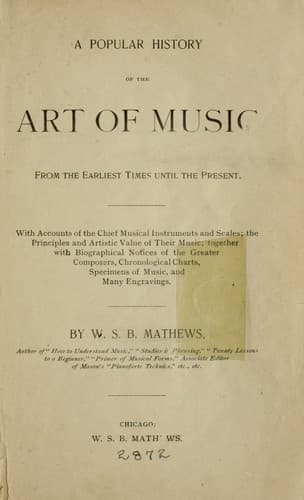
A Popular History of the Art of Music: From the Earliest Times Until the PresentMathews, W. S. B. (William Smythe Babcock)
History
A Popular History of the Art of Music: From the Earliest Times Until the Present
Mathews, W. S. B. (William Smythe Babcock)
Music -- History and criticism
Two years later he was invited to assume the assistant directorship of
the private orchestra and choir of Prince Esterhazy, who lived in
magnificent style, and for many years had maintained a private musical
chapel. Very soon the old prince died, and his son reigned in his
place. The new master was the one named "The Magnificent," and greatly
enlarged the musical appointment of his predecessor. He built a great
palace at Esterhaz, where there was a theater, in which opera was
given, and a smaller one where there was a marionette company, the
machinery of which had been brought to great perfection. There were
frequent concerts. The prince was a great amateur of the peculiar viol
called the barytone, and it was one of Haydn's duties to provide new
compositions for this instrument. Here for thirty years he continued
in service, with few interruptions, and always on the very best of
terms with his prince, and with the men under him. The players called
Haydn "Papa."
[Illustration: Fig. 53.]
Owing to its situation, remote from town, and to the prince's
constantly increasing aversion to living in Vienna, Haydn scarcely
left the vicinity for years together. Here, wholly from within his own
resources, he evolved a succession of works in every style, and for
almost every possible combination of instruments, from operas for the
large theater, to marionette music for the small place, orchestral
compositions, among which the 175 symphonies form a not inconsiderable
portion; there are also concertos for many kinds of instruments, and
songs, masses, _divertissements_ and the like. In short, there is
scarcely any form of music which Haydn did not have to make at some
time or other in his long service in the Esterhazy establishment.
Being his own orchestral director, he had the opportunity of trying
and experimenting and of realizing what would be effective and what
would not. The motive mainly operative in his work, necessarily, was
that of pleasing and amusing. Nobler intentions were not wanting, but
the pleasing element had to be considered in most that he did. Thus
he developed a style of his own, original, becoming, with a certain
taste and symmetry, and with a melodious element which never loses its
charm. Withal he became very clever in his treatment of themes. It was
a saying of his that the "idea" did not matter at all; "treatment is
everything." From this standpoint it is impossible to deny Haydn the
credit of having accomplished his ideal.
Public-domain text, read in full here on John Shaqi.
Reviews
Reviews
No reviews yet
Be the first to share your thoughts on this work.
Elsewhere in the archive
Join the Discussion
Join the discussion
Sign in to leave a comment or review.
Sign InorCreate an account