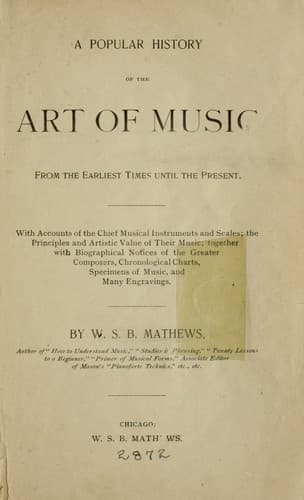
A Popular History of the Art of Music: From the Earliest Times Until the PresentMathews, W. S. B. (William Smythe Babcock)
History
A Popular History of the Art of Music: From the Earliest Times Until the Present
Mathews, W. S. B. (William Smythe Babcock)
Music -- History and criticism
Meanwhile, as a man Beethoven had been subject to his vicissitudes,
but upon the whole, while no longer the popular composer of the day
(his seriousness prevented that) he was in comfortable circumstances,
but annoyed by the care of a nephew of irregular habits and
reprehensible character. For many years now Beethoven had been getting
deaf, and for the past ten or twelve he had been unable to hear
ordinary conversation, so that communication had to be carried on with
him by writing. Superficial observers inferred from this fact that
the inability to hear his compositions must have reacted unfavorably
upon them, and probably accounted for many passages which were unlike
his early works, and unintelligible or unlovely to the critics
aforesaid. It is true that between the early and the latest
compositions of Beethoven there is a greater difference in
intelligibility than between the early and the late compositions of
any other master. But the difference is not one of judgment on his
part, but purely one of different conception, different melodic
structure and deeper effect. The ninth symphony, which the first
players called impossible, has lived to be counted not simply the
greatest of all of Beethoven's works, but the greatest of _all_
instrumental music. It has been named as an impassable barrier beyond
which no later composer might pass and compose an instrumental
symphony. Nothing could be more unjust or mistaken. Every composition
of Beethoven is a fantasia, which in his earlier work indeed has the
form of the sonata, the accepted serious form of the day; but in the
works of the middle period, the limits of the sonata form were crossed
in many directions, and in the latest the sonata is forsaken entirely.
But this is not to say that Beethoven had gone beyond the sonata form.
Beethoven was an improviser in music, quite as surely as his wildest
successor, Schumann, and he wrote as he felt at the time. He lost
nothing in being deaf. His inner tonal sense was as acute as ever, and
had been trained as the tonal sense of few composers ever was. In
point of fact the compositions of the later period are as sweet as
those of any former period whatever. The last sonata for the
pianoforte is one of the most advanced compositions that exist for the
instrument. It is a tone poem which will outlast most other things
that Beethoven wrote for this instrument. In fact, the accuracy with
which the capacity of the instrument is gauged is one of the most
striking peculiarities of the last sonatas and other late works of
this master. Meanwhile, piano technique has advanced to a point where
these great works no longer present the insurmountable difficulties
that they did when first composed. Their general acceptance has been
delayed by the foolish notion that there was about them something
sacred and secluded from the apprehension of ordinary readers. This is
not the case. They are within reach, and repay study.
Public-domain text, read in full here on John Shaqi.
Reviews
Reviews
No reviews yet
Be the first to share your thoughts on this work.
Elsewhere in the archive
Join the Discussion
Join the discussion
Sign in to leave a comment or review.
Sign InorCreate an account