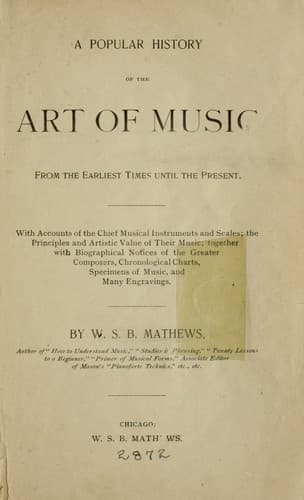
A Popular History of the Art of Music: From the Earliest Times Until the PresentMathews, W. S. B. (William Smythe Babcock)
History
A Popular History of the Art of Music: From the Earliest Times Until the Present
Mathews, W. S. B. (William Smythe Babcock)
Music -- History and criticism
After Lulli, the next great name in the history of French opera was
that of Jean Philippe Rameau (1683-1765). This great master was one of
the most versatile men of whom we have a record in music. He was a
mathematician, physicist, a profound theorist, and a virtuoso upon the
piano and harpsichord. He is one of the four great names in music of
the period of Bach and Haendel, the fourth being Scarlatti. His
education in music began while he was very young, and it is said of
him that such was his talent that he could improvise a fugue upon any
theme assigned, when he was but fourteen years of age. His father
wished him to be trained for the law, but music had greater charms for
him, and the margins of his books were marked over with crotchets and
quavers. Having become desperately in love with a fascinating young
widow, whom his father was opposed to his marrying, he was sent at the
age of seventeen to Italy, ostensibly to study. He came, therefore, to
Milan about 1701, a few years before Haendel came there. Italian music
was little to his taste. The dignified declamation of the Lulli operas
seemed to him better worthy the attention of men than the tunes of the
Italians. Accordingly he took service as a violinist with a traveling
operatic troupe, and in this capacity visited the south of France. In
Paris he became a pupil of the court organist Marchand, of whom we
hear again in connection with certain tests of proficiency with
Haendel. Marchand was at first delighted with his new pupil, but
presently dropped him when he discovered how talented he was, and
liable to prove a dangerous rival. Accordingly he left Paris and took
service as organist at Lille, which post he exchanged afterward for
one at Clermont. In this quiet town he devoted himself to the study of
harmony, and to reflection upon the principles of music. He read here
the works of Zarlino, and other Italian theorists, and in 1721 he
returned to Paris and published his treatise on harmony, in which he
propounded the theory of inversions. His second treatise on harmony,
"New System of Musical Theory," was published in 1725. These works
excited a great deal of attention and brought the author renown, but
his soul yearned for recognition as composer, and in 1730 he obtained
from Voltaire a libretto, "Samson." This work was declined at the
national opera, on the ground that the public was not attracted by
Biblical subjects. Three years later, however, he composed another,
"_Hypolite et Arcie_," which was performed with moderate success. He
had now reached the age of fifty, and entered upon the second stage of
his artistic career, and the second period of the French opera. The
admirers of Rameau invited appreciation of the new works upon the
ground of their being better than those of Lulli, and all Paris was
divided into two opposite camps. Rameau is entitled to having
developed his operas more musically than those of Lulli, and the later
ones became still richer upon the orchestral side.
Public-domain text, read in full here on John Shaqi.
Reviews
Reviews
No reviews yet
Be the first to share your thoughts on this work.
Elsewhere in the archive
Join the Discussion
Join the discussion
Sign in to leave a comment or review.
Sign InorCreate an account