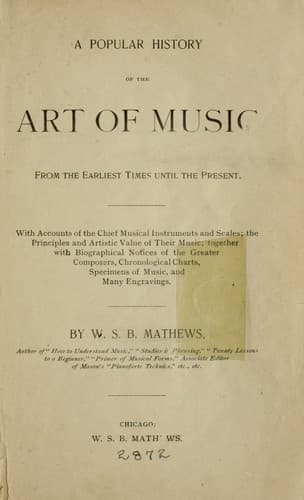
A Popular History of the Art of Music: From the Earliest Times Until the PresentMathews, W. S. B. (William Smythe Babcock)
History
A Popular History of the Art of Music: From the Earliest Times Until the Present
Mathews, W. S. B. (William Smythe Babcock)
Music -- History and criticism
It was during the eighteenth century that the pianoforte definitely
established itself in the estimation of musicians, artists and the
common people, as the handiest and most useful of domestic and solo
instruments. The progress was very slow at first, the musicians such
as Bach, Haendel, Scarlatti and Rameau, the four great virtuosi of the
beginning of this century, generally preferred the older forms of the
instrument, the clavier or the harpsichord, both on account of their
more agreeable touch and the sweetness of their tones. Nevertheless
the style of playing and of writing for these instruments underwent a
gradual change at the hands of these very masters, of such a character
that when the pianoforte became generally recognized as superior to
its predecessors, about the middle of the century, the compositions of
Bach and Scarlatti were found well adapted to the newer and more
powerful instrument. The pianoforte itself underwent several
modifications from the primitive forms of action devised by Cristofori
in 1711, rendering it more responsive to the touch. All this, relating
to the mechanical perfection of the instrument, although appropriate
in part to the present moment of the narrative, is deferred until a
later chapter, when the entire history of this instrument will be
considered in detail. From that it will be seen, by comparing dates,
that every important mechanical step in advance was followed by
immediate modifications of the style of writing and playing, whereby
the progress toward fullness and manifold suggestiveness of music for
this instrument has been steady and great.
The first of the great virtuosi was Domenico Scarlatti (1683-1757),
son of the great Alessandro Scarlatti, and a pupil of his father, and
of other masters whose names are now uncertain. He was a moderately
successful composer of operas and works for the Church, but his
distinguishing merit was that of a virtuoso upon the harpsichord--the
pianoforte of that time. He was the first of the writers upon the
harpsichord who introduced difficulties for the pleasure of overcoming
them, and who, in his own country, was without peer as performer until
Haendel came there and surpassed him, in 1708. Scarlatti was also a
performer upon the organ, but upon this instrument he unhesitatingly
confessed Haendel to be his superior. In 1715 Scarlatti succeeded Baj
as chapel master at St. Peter's in Rome, where he composed much church
music. His operas were successful in their own day, but were soon
forgotten. His pianoforte compositions still remain as a necessary
part of the education of the modern virtuoso. They are free in form,
brilliant in execution, and melodious after the Italian manner. Many
of them are still excessively difficult to play, in spite of the
progress in technique which has been made since.
Public-domain text, read in full here on John Shaqi.
Reviews
Reviews
No reviews yet
Be the first to share your thoughts on this work.
Elsewhere in the archive
Join the Discussion
Join the discussion
Sign in to leave a comment or review.
Sign InorCreate an account