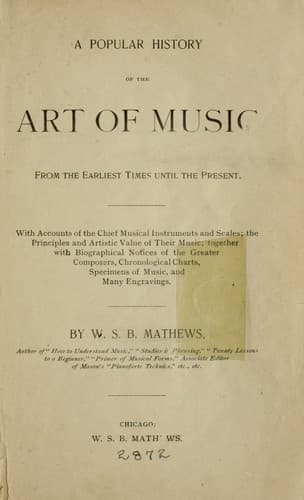
A Popular History of the Art of Music: From the Earliest Times Until the PresentMathews, W. S. B. (William Smythe Babcock)
History
A Popular History of the Art of Music: From the Earliest Times Until the Present
Mathews, W. S. B. (William Smythe Babcock)
Music -- History and criticism
beyond the demands of these later sonatas of the great Vienna master.
In the later part of the eighteenth century there were a number of
pianoforte virtuosi whose merits claim our attention at this point. At
the head, in point of time, was the great Italian master, Muzio
Clementi (1752-1832). Born at about the same time as Mozart, he
outlived Beethoven. His early studies were pursued at Rome with so
much enthusiasm that at the age of fourteen he had produced several
important compositions of a contrapuntal character. These being
successfully performed, attracted the attention of an English amateur
living in Rome, who offered to take charge of the boy, carry him to
England and see that his career was opened under favorable auspices.
Until 1770, therefore (the year of Beethoven's birth), Clementi
pursued his studies near London. Then, in the full force of his
remarkable virtuosity, he burst upon the town. He carried everything
before him, and had a most unprecedented success. His command of the
instrument surpassed everything previously seen. After three years as
cembalist and conductor at the Italian opera in London, he set out
upon a tour as virtuoso. In 1781 he appeared in Paris, and so on
toward Munich, Strassburg, and at length Vienna, where he met Haydn,
and where, at the instigation of the Emperor Joseph II, he had a sort
of musical contest with the young Mozart. Clementi, after a short
prelude, introduced his sonata in B flat, the opening motive of which
was afterward employed by Mozart in the introduction to the overture
to the "Magic Flute"; and followed it up with a toccata abounding in
runs in diatonic thirds and other doublestops for the right hand, at
that time esteemed very difficult. The victory was regarded as
doubtful, Mozart compensating for his less brilliant execution by his
beautiful singing touch, of which Clementi ever afterward spoke with
admiration. Moreover, from this meeting he himself endeavored to put
more music and less show into his own compositions. Clementi was soon
back in England, where he remained until 1802, when he took his
promising pupil, John Field, inventor of the nocturne, upon a tour of
Europe, as far as St. Petersburg, where they were received with
unbounded enthusiasm. In 1810 he returned to London and gave up
concert playing in public. He wrote symphonies for the London
Philharmonic Society, published very many sonatas for piano (about 100
in all), and in 1817 published his master work, a set of 100 studies
for the piano, in all styles, the "_Gradus ad Parnassum_," upon which
to a considerable extent the entire modern art of piano playing
depends. Clementi's idea in the work was to provide for the entire
training of the pupil by means of it; not alone upon the technical,
but upon the artistic side as well, and the majority of the pieces
have artistic purpose no less than technical. The wide range taken by
piano literature since Clementi's day, however, reduces the teacher to
Public-domain text, read in full here on John Shaqi.
Reviews
Reviews
No reviews yet
Be the first to share your thoughts on this work.
Elsewhere in the archive
Join the Discussion
Join the discussion
Sign in to leave a comment or review.
Sign InorCreate an account