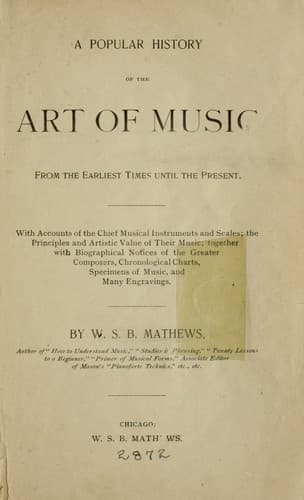
A Popular History of the Art of Music: From the Earliest Times Until the PresentMathews, W. S. B. (William Smythe Babcock)
History
A Popular History of the Art of Music: From the Earliest Times Until the Present
Mathews, W. S. B. (William Smythe Babcock)
Music -- History and criticism
sideways upon the platform, although the later ones may not have had
an interesting profile to exhibit."
The published works of this fine musician and creditable composer
number nearly 100, and the sonata cuts a leading figure among them. He
treated the piano with much more freedom and breadth than Mozart,
though this is not so much to his credit as if he had not lived many
years after Mozart died, his earliest compositions falling very near
the last years of that great genius. He was distinctly a virtuoso,
loving his instrument and its tonal powers. He was the first of all
the players whose public performances called attention to the
_quality_ of tone, and its _singing_ power. This also points not alone
to the fact of his career falling in with the increased powers of the
pianoforte, as a result of the inventions of Erard, Collard and
Broadwood, but is to his personal credit, since it was genius in him
enabling him to recognize these possibilities, at a time when most
players were still in ignorance of them. As a composer he wrote many
things of more than average excellence, and some of his lighter
compositions still have vitality. It is altogether likely that
Beethoven was influenced by Dussek's playing, in the direction of
tone-color. Indeed, the third sonata of Beethoven can hardly be
accounted for without recognizing Dussek as the composer upon some one
of whose works its general style and form were modeled.
Another pianist of considerable importance, a disciple of Mozart, yet
with originality of his own, was J.B. Cramer (1771-1858). This
talented and deserving musician was the son of a musician living at
Mannheim, who removed to London when the young Cramer was but one year
old. There the boy grew up, receiving his education from several
reputable masters, Clementi being among them. His taste was formed by
the diligent study of the works of Emanuel Bach, Haydn and Mozart. In
spirit Cramer was a disciple of the last named, but from living to a
good old age, he naturally surpassed his ideal in the treatment of the
pianoforte. In the latter part of the eighteenth century there were
few musical compositions sold over the music counters in Vienna and
the musical world generally, but those of Dussek, Cramer and Pleyel,
while those of Beethoven were comparatively neglected. Cramer's
compositions were slight in real merit, his fame resting upon his
studies for the piano, of which about thirty out of the entire 100 are
very good music. The second, and last, book of these were published
in 1810. They do not form a necessary part of the training of a
virtuoso, but they have decided merits, and are generally included to
this day in the list of pianistic indispensables. Cramer's style of
playing was quiet and elegant. Moscheles gives an idea of it in his
diary, and regrets that he should allow the snuff, which he took
incessantly, to get upon the keys. Cramer's studies preceded those of
Public-domain text, read in full here on John Shaqi.
Reviews
Reviews
No reviews yet
Be the first to share your thoughts on this work.
Elsewhere in the archive
Join the Discussion
Join the discussion
Sign in to leave a comment or review.
Sign InorCreate an account