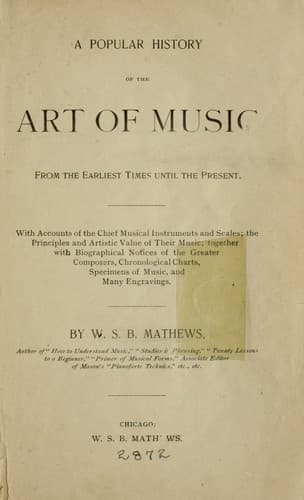
A Popular History of the Art of Music: From the Earliest Times Until the PresentMathews, W. S. B. (William Smythe Babcock)
History
A Popular History of the Art of Music: From the Earliest Times Until the Present
Mathews, W. S. B. (William Smythe Babcock)
Music -- History and criticism
The progress in piano playing, in the course of the nineteenth century
has been most extraordinary. The music of Beethoven and Schubert,
composed during the first quarter of this century, and the influence
of the virtuosi prominent during that time, whose activity has been
told in connection with those of the century previous (the operative
principles of which were the ones mainly influencing them); and the
continual strife of the piano makers to increase the resonance,
singing quality and artistic susceptibility of the tone and the
strength and elasticity of the action, as recounted in the
chapter devoted to the history of this, the greatest of modern
instruments--were concentrating influences having the effect of
calling attention to the new instrument in a very remarkable manner.
Add to these causes the meteor-like appearance of Paganini, with his
stupendous execution upon the violin, and its novel possibilities. All
these together seem to have led four gifted geniuses at about the same
time to make independent investigations into the tonal possibilities
of the piano, and the mode of producing effects upon it, in the hope
of creating a new art, and of rivaling the weird successes of the
highly gifted Italian, who apparently had exhausted the possibilities
of the violin. The artists thus occupied in developing the art of
piano playing were Chopin, Liszt, Thalberg and Schumann, and it is far
from easy to determine exactly which one it was who first brought his
influence to bear upon the public; or which one it was who first
arrived at the successful application of the principles of the new
technique, whose essential divergences from the old consisted in a
more flexible use of the fingers, hand and arm, and the co-operation
of the foot for the promotion of blending, and of bringing into
simultaneous use the tonal resources from all parts of the instrument.
In this case, as in so many others of remarkable invention, the
improvements seem to have been made by several independent
investigators acting simultaneously, each one ignorant of the work of
the others. The impulse in the direction of greater freedom had
already found expression in the pianoforte pieces of the great master,
Von Weber, whose sonatas and caprices had been published between 1810
and 1820. (See pp. 410 and 411.) These contain several novelties,
which I have found it more convenient to discuss in connection with
the personal history of the composer. Liszt has generally been held as
a little the earliest of the four in point of time, his arrangement of
Berlioz's "Harold" symphony having been published, according to the
dates in Weitzmann's history, in 1827, but according to more accurate
information, in 1835, while he had published his arrangement of the
Paganini caprices in 1832, one year after hearing Paganini. In these
works Liszt makes demands upon the hands which were not recognized as
among the possibilities of the old technique. But for all this, it is
Public-domain text, read in full here on John Shaqi.
Reviews
Reviews
No reviews yet
Be the first to share your thoughts on this work.
Elsewhere in the archive
Join the Discussion
Join the discussion
Sign in to leave a comment or review.
Sign InorCreate an account