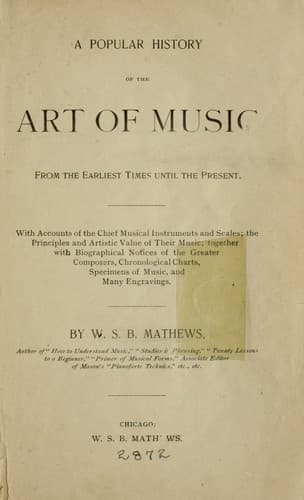
A Popular History of the Art of Music: From the Earliest Times Until the PresentMathews, W. S. B. (William Smythe Babcock)
History
A Popular History of the Art of Music: From the Earliest Times Until the Present
Mathews, W. S. B. (William Smythe Babcock)
Music -- History and criticism
In 1849 a new epoch was opened in the history of this remarkable man.
The grand duke of Weimar invited him to assume the direction of his
musical establishment, including the opera. The salary was absurdly
small--$800 or $1,000 a year. This, however, cut no figure in Liszt's
mind, for he had always been singularly open-handed, yet at same time
prudent. From his successful concert tours he had put by funds, 20,000
francs for his aged mother, and 20,000 francs for each of the three
children he had by the Countess D'Agoult (known in literature as
Daniel Stern), and he considered that the position would afford him an
opportunity of developing his own talent for composition, and at the
same time of affording a hearing for important new works, which, on
account of their novelty and originality, were impossible of
performance in the theaters of large cities. The repertory of the
Weimar opera, from this time on, was most extraordinary. Here were
produced for the first time Wagner's "Flying Dutchman,"
"_Tannhaeuser_," and "_Lohengrin_," "_Benvenuto Cellini_," of Berlioz,
Schumann's "_Genoveva_" and "_Mannfred_," and Schubert's "Alfonso and
Estrella." Here were produced, also, the best of the operas of
previous generations. Every master work of this sort Liszt revised
with the greatest care, giving endless patience to every detail, and
supplementing the resources of the theater, when insufficient, by
"guests" from the great operas in the capital. Thus the musical
establishment at Weimar became a sort of Mecca, to which all the
musicians of the world gathered, especially the young and energetic in
the pursuit of knowledge, and creative artists seeking a hearing or
fresh inspiration. From an artistic standpoint, nothing more beautiful
than the life of Liszt at Weimar could be desired. Besides these
operatic performances and his symphony concerts, he gathered about him
a succession of young virtuosi pianists. These had lessons, more or
less formally, some of them for many years. Liszt never received money
for lessons, and took no pupils but those whom he regarded as
promising, or who were personally attractive to himself. About 1850
the American, Dr. William Mason, was there, and for two years
following. The class at this time contained the well known names of
Rubinstein, Carl Klindworth, Pruckner, Tausig, Joachim Raff, and Hans
von Buelow. From this time on there is scarcely a concert pianist in
the world who did not spend a few months or longer with Liszt at
Weimar. Nor did his influence stop here. He produced a constant
succession of important works, and conducted concerts and festivals in
Hungary, and in different parts of Germany and France. Everywhere his
inspiring presence and his keen insight were prized above all ordinary
resources.
Public-domain text, read in full here on John Shaqi.
Reviews
Reviews
No reviews yet
Be the first to share your thoughts on this work.
Elsewhere in the archive
Join the Discussion
Join the discussion
Sign in to leave a comment or review.
Sign InorCreate an account