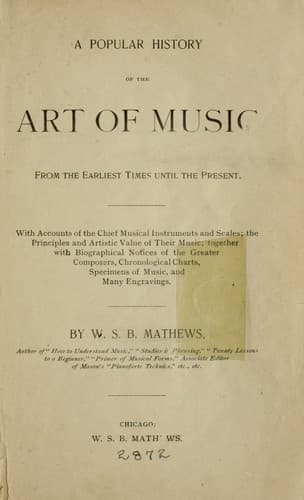
A Popular History of the Art of Music: From the Earliest Times Until the PresentMathews, W. S. B. (William Smythe Babcock)
History
A Popular History of the Art of Music: From the Earliest Times Until the Present
Mathews, W. S. B. (William Smythe Babcock)
Music -- History and criticism
him play before Goethe, and a trio of the boy's was also played, after
which he was sent to play in the garden while his seniors discussed
his prospects. Thus the boy grew up under the most favorable
circumstances possible, his father being a wise and careful man, who,
although not a musician, thoroughly sympathized with the artistic aims
of his son; and his mother also encouraged him to more serious
efforts. Even at this early age he was a prolific composer of
orchestral music, the year 1824 being that of the composition of the
symphony in C minor, now known as No. 1, but in Mendelssohn's
catalogue marked the thirteenth of his compositions. In this year
Moscheles passed through Berlin on his way to London, and made the
acquaintance of Mendelssohn. At the Sunday morning music in the
Mendelssohn house, Moscheles recalls the performance of Felix's C
minor quartette, D major symphony, a concerto by Bach, played by
Fanny, and a duet for two pianos. In the same year Spohr came to
Berlin, and a little later Hiller, both of whom speak of
Mendelssohn's playing as something very remarkable. His celebrated
octette for strings, Opus 20, was composed in 1825. This was the first
of his works which has retained its popularity. The year following he
composed the overture to "The Midsummer Night's Dream," one of the
most remarkable pieces of the early romantic school. In this the
fairy-like music of Titania and her elves is charmingly contrasted
with the folk songs and the absurd bray of the transformed Bottom. He
had already written an opera "_Camacho_," which had been submitted to
Spontini, the musical director of Berlin, but it was never performed.
He entered at the University and attended the lectures of Hegel and
Carl Ritter, the geographer, but for mathematics he had no talent. Two
folio volumes of notes of the lectures of Hegel and Ritter are
preserved from the years 1827 and 1828. His overture to "The Calm Sea
and Prosperous Voyage" was written in 1828. In the year following he
started on a long journey of three years, carefully planned by his
father, in which all the countries of Europe were to have been visited
successively, and observations made on civilization and society. His
first appearance before an English audience was at a Philharmonic
concert, May 25, 1828, when he conducted his symphony in C minor and
improvised on the piano. He was received with the utmost applause.
Five days later he played the _Concertstueck_ of Von Weber, and, which
was a great innovation at that time, with no music before him. His
letters from London are very charming indeed. At a concert later, his
overture to "The Midsummer Night's Dream" was performed with great
success; this was the beginning of his English popularity, lasting all
the rest of his life.
Public-domain text, read in full here on John Shaqi.
Reviews
Reviews
No reviews yet
Be the first to share your thoughts on this work.
Elsewhere in the archive
Join the Discussion
Join the discussion
Sign in to leave a comment or review.
Sign InorCreate an account