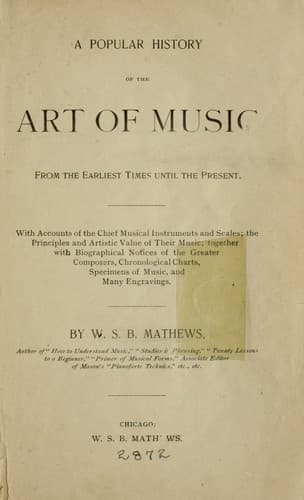
A Popular History of the Art of Music: From the Earliest Times Until the PresentMathews, W. S. B. (William Smythe Babcock)
History
A Popular History of the Art of Music: From the Earliest Times Until the Present
Mathews, W. S. B. (William Smythe Babcock)
Music -- History and criticism
The famous G minor concerto for the piano was first produced in Munich
in 1831. In the same year he went to Paris, where many of his works
were performed and others were composed. The next year he was in
London again, when the Hebrides overture was produced and the first
book of "Songs without Words" was published. He also played the organ
at several of the churches, and excited general admiration by his
vigorous style. He is said to have been the first to play a Bach pedal
fugue in England, certainly the first to play any of the important
ones. In 1833 he was settled at Duesseldorf, as musical director of the
church and two associations. There he immediately instituted a reform
in the music of the church, and in the character of the selections for
concert. In the church there were masses by Beethoven and Cherubini,
motettes by Palestrina, and cantatas by Bach. The next year his
oratorio of "St. Paul" was begun. In 1837 he was married to a very
charming lady--Miss Cecilia Jeanrenaud, daughter of a clergyman of the
Reformed Church at Frankfort. Very soon after the wedding he was in
London and Birmingham, where he conducted "St. Paul" and commenced to
prepare the libretto for his oratorio of "Elijah." Among the Bach
fugues which he played in London on the organ at this time were the D
major, the G minor, the E major, the C minor and the short E minor.
His pedal playing was very highly esteemed.
[Illustration: Fig. 85.
MORITZ HAUPTMANN.]
In 1835 he commenced to conduct the _Gewandhaus_ concerts at Leipsic,
and the celebrated conservatory there was founded in 1843. The first
professors were Hauptmann, David, Schumann, Pohlenz and C.F. Becker.
Ferdinand David (1810-1873) was the greatest master of the violin
during the third quarter of the century. Moritz Hauptmann
(1792-1868), originally a violinist, was one of the most original
theorists of this century. His greatest work, "Harmony and Meter," was
published in 1853. Soon afterward Moscheles became associated with
them. The city of Leipsic remained his home during the remainder of
his life. The founding of the conservatory may have been hastened by
certain plans which Mendelssohn had endeavored three years before to
get adopted in Berlin, where there was a project for founding a royal
music school upon a different basis from any at that time existing.
From some change in the ministry, or temporary political disturbance,
the plan fell through, but in Leipsic it was carried out. This famous
school from that time forward, for nearly fifty years, exercised an
influence greater than that of any other music school in the world.
Among its graduates are a very large number of the most successful
teachers and celebrated professional musicians. They had been drawn to
Leipsic by the reputation given the conservatory by the possession of
such masters as Mendelssohn, Schumann, Hauptmann, Moscheles, Plaidy,
Dr. Paul, Becker, Brendel, Reinecke and others. After Mendelssohn's
Public-domain text, read in full here on John Shaqi.
Reviews
Reviews
No reviews yet
Be the first to share your thoughts on this work.
Elsewhere in the archive
Join the Discussion
Join the discussion
Sign in to leave a comment or review.
Sign InorCreate an account