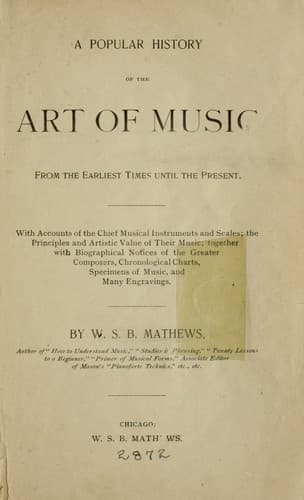
A Popular History of the Art of Music: From the Earliest Times Until the PresentMathews, W. S. B. (William Smythe Babcock)
History
A Popular History of the Art of Music: From the Earliest Times Until the Present
Mathews, W. S. B. (William Smythe Babcock)
Music -- History and criticism
In spite of the few examples reaching foreign countries, there is a
continuous and rather abundant production of light and serious operas
in Italy, every principal theater making it a point to bring out one
or more new works every season. The best of these, after a long
interval, become known abroad. It is a great mistake to suppose that
the few Italian operas of recent date performed in England and America
adequately represent the present state of Italian art.
CHAPTER XXXVIII.
FRENCH OPERATIC COMPOSERS OF THE NINETEENTH CENTURY.
In the earlier part of the nineteenth century the operatic stage of
Paris shared with those of Berlin and Dresden the honor of producing
brilliant novelties by the best composers. In France there had been a
persistent cultivation of this province of musical creation, and many
talented composers have appeared upon the scene of the Grand Opera and
that of the _Opera Comique_. French opera has developed into a genre
of its own, rhythmically well regulated, instrumented in a pleasing
and attractive manner, and staged with considerable reference to
spectacular display.
[Illustration: Fig. 90.
AUBER.]
The oldest of these masters to achieve distinction, and the one most
successful in gaining the ear of other countries than France, was
Daniel Francois Esprit Auber (1782-1870). He was born in Caen, in
Normandy, of a family highly gifted and artistic in temperament.
Nevertheless, his father intended him for a merchant, and sent him to
England in 1804, in the hope that the study of commercial success
there might wean him from his love of music. But the boy came back
more musical than ever. After composing several pieces, a little
opera, a mass, etc., his first opera to be publicly performed was
"_Le Sejour Militaire_." During the fifteen years next following he
wrote a succession of light operas for the smaller theaters of Paris,
most of them with librettos by Scribe. No one of these works had more
than a temporary success, and the names are not sufficiently important
to be given here. At length, in 1828, he produced his master work,
"_La Muette di Portici_," otherwise known as "_Masaniello_," which at
once placed its author upon the pinnacle of fame. This was an opera
upon the largest scale, and was the first in order of the three great
master works which adorned the Paris stage during this and the three
years following. The others were Rossini's "Tell" in 1829, and
Meyerbeer's "Robert" in 1831. The subject was fortunately related to
the spirit of the times, Masaniello having been leader of the
insurgents in Naples. The work well deserved its success, since for
melody and pleasing effects it has rarely been surpassed. The overture
is still much played as a concert number, but the opera itself has
nearly left the stage, excepting in Germany, where it still has a
distinguished place. All his later works were lighter than
"_Masaniello_." They were "_La Fiancee_" (1829), the extremely
Public-domain text, read in full here on John Shaqi.
Reviews
Reviews
No reviews yet
Be the first to share your thoughts on this work.
Elsewhere in the archive
Join the Discussion
Join the discussion
Sign in to leave a comment or review.
Sign InorCreate an account