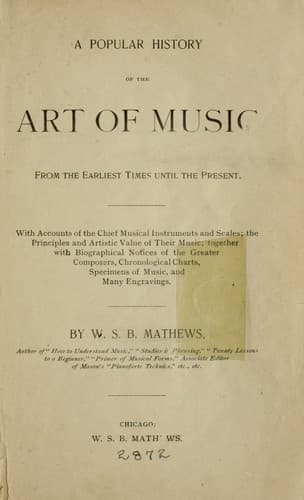
A Popular History of the Art of Music: From the Earliest Times Until the PresentMathews, W. S. B. (William Smythe Babcock)
History
A Popular History of the Art of Music: From the Earliest Times Until the Present
Mathews, W. S. B. (William Smythe Babcock)
Music -- History and criticism
Among the better composers of the later French school was Felix Marie
Victor Masse (1822-1884), who experienced the usual fortunes of the
better class of French composers, having taken the prize of Rome in
1844 and produced his first opera, "_La Chanteuse Voilee_," in 1850,
which was followed by his "_Galathea_" in 1852 and the "Marriage of
Jeanette" in 1853. Encouraged by these successes he produced a large
number of operas in Italy, of which the best were "_La Reine Topaze_"
(1856) and "_Les Saisons_" (1855). In 1860 he became chorus master at
the Academy of Music, and in 1866 professor of composition at the
Conservatory. In 1872 he was elected to the Institute as successor of
Auber. In addition to the works already mentioned he produced "Paul
and Virginia" (1866), and several others, besides a number of songs.
His last opera, "_Le Mort de Cleopatre_," was written during his long
sickness, and on the whole was not a success.
Another pleasing French composer is Jules Emile Frederic Massenet
(1842- ), who took the prize of Rome in 1863, and in 1867 produced his
first opera, "_La Grande Tante_." In addition to this he composed a
number of operas, "_Le Roi de Lahore_" (1877), "_Marie Madeleine_"
(1873), an oratorio, and "Eve" in 1875. He has also written a number
of orchestral suites which have been very popular in all countries.
His latest work, "_Le Mage_," was produced at the Grand Opera, Paris,
March, 1891.
One of the most brilliant and versatile of the French musicians of
this generation is M. Camille Saint-Saens (1835- ), a virtuoso upon
the piano and organ, and an orchestral tone-poet of very rare quality.
Educated in the Conservatory, he composed his first symphony when he
was sixteen, and was organist of the Church of St. Marri at the age of
eighteen. In 1858 he became organist at the Madeleine. He has produced
a number of operas, of which "_Le Timbre d'Argent_" (1887), "Samson
and Delilah" (1877), and "_Etienne Marcel_" (1879), "Henry VIII"
(1883) and "_Ascanio_," produced in 1890 at the Grand Opera. In
addition to these, Saint-Saens has produced a large number of
orchestral pieces, including "_Le Mouet d'Omphale_," "_Le Dance
Macabre_," and other symphonic poems of the programme character. He
has also written several oratorios, of which "The Deluge" is the most
important, and a large amount of chamber and pianoforte music. He is a
brilliant writer about music, and is favorably known in Germany and
all the rest of Europe as a virtuoso upon the piano and organ. His
second concerto for piano is one of the best virtuoso pieces for that
instrument. In his "_Melodie et Harmonie_," a collection of newspaper
essays, he discusses many interesting questions. His fame with
posterity is more likely to rest upon his orchestral pieces, which are
extremely clever and interesting, than upon his operas. Personally he
is said to be very witty and entertaining. He has been a member of the
Institute since 1874.
Public-domain text, read in full here on John Shaqi.
Reviews
Reviews
No reviews yet
Be the first to share your thoughts on this work.
Elsewhere in the archive
Join the Discussion
Join the discussion
Sign in to leave a comment or review.
Sign InorCreate an account