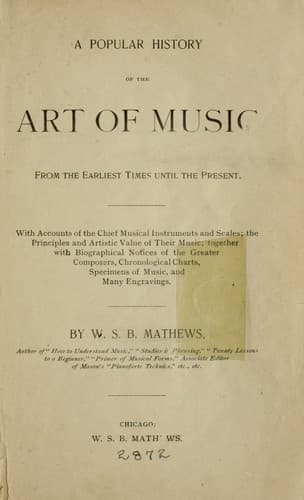
A Popular History of the Art of Music: From the Earliest Times Until the PresentMathews, W. S. B. (William Smythe Babcock)
History
A Popular History of the Art of Music: From the Earliest Times Until the Present
Mathews, W. S. B. (William Smythe Babcock)
Music -- History and criticism
Even greater than Rubinstein as composer was the brilliant Peter
Ilitsch Tschaikowsky (1840-1893). Tschaikowsky was intended for the
profession of the law, in which he took his degree. But his love for
music asserted itself, and after a short career as pupil in the St.
Petersburgh conservatory, he was appointed teacher of harmony in that
institution, and entered upon his career as composer. Here he remained
but a short time, resigning in 1877, after which he lived by turns at
St. Petersburgh, in Italy and in Switzerland. Tschaikowsky was of a
lyric musical nature, and in his early life his taste was entirely for
Italian music. This shows to a remarkable degree in all his earlier
productions, even if he had not himself published the fact so often
and unmistakably. In 1869 he produced his first Russian opera, "Der
Woiwode" which was followed by eight others, of which the best known
are "Eugene Onegin" and "Makula, the Smith." Several of these are now
played throughout Europe. It was in his orchestral compositions,
however, that Tschaikowsky most illustrated his unexampled powers.
Besides a number of brilliant and highly sensational overtures, he
composed six symphonies, of unexampled sonority, rich coloring and
strange musical expression. The fifth symphony of Tschaikowsky met
with almost universal recognition at the hands of the leading
orchestral conductors of the world; and the last, the so-called
"Tragic," only deepened the impression of the composer's powers.
Several points are unusual. The themes themselves are original,
forceful and lend themselves easily to elaboration. The harmonic
treatment is highly original, as if the author had found, as Buelow
said, "new harmonic paths." The instrumentation is richly colored and
the climaxes are of vast power and effect. The whole is a grandly
composed tone poem which even if regarded as surpassing the proper
reserve of symphonic form must nevertheless be counted as one of the
most valuable enrichments of the world's orchestral repertory. In
several places in his works Tschaikowsky introduces peculiarities of
Russian folk music, as for example in the movement in 5-4 measure in
the fifth measure symphony. Nevertheless, the works belong to the
world's music, being in no sense provincial, narrow or limited.
AEsthetically considered, they illustrate the quick technique and
over-mastering energy of the race to which the composer belonged.
III. MUSIC IN BOHEMIA.
Public-domain text, read in full here on John Shaqi.
Reviews
Reviews
No reviews yet
Be the first to share your thoughts on this work.
Elsewhere in the archive
Join the Discussion
Join the discussion
Sign in to leave a comment or review.
Sign InorCreate an account