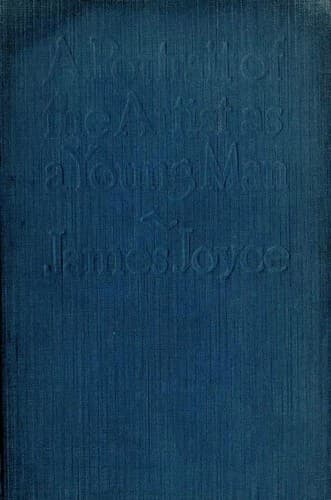
A Portrait of the Artist as a Young ManJoyce, James
General
A Portrait of the Artist as a Young Man
Joyce, James
Artists -- Fiction; Autobiographical fiction; Bildungsromans; Dublin (Ireland) -- Fiction; Young men -- Fiction
—I may not have his talent, said Stephen quietly.
—You never know, said the dean brightly. We never can say what is in
us. I most certainly should not be despondent. _Per aspera ad astra._
He left the hearth quickly and went towards the landing to oversee the
arrival of the first arts’ class.
Leaning against the fireplace Stephen heard him greet briskly and
impartially every student of the class and could almost see the frank
smiles of the coarser students. A desolating pity began to fall like
dew upon his easily embittered heart for this faithful servingman of
the knightly Loyola, for this halfbrother of the clergy, more venal
than they in speech, more steadfast of soul than they, one whom he
would never call his ghostly father; and he thought how this man and
his companions had earned the name of worldlings at the hands not of
the unworldly only but of the worldly also for having pleaded, during
all their history, at the bar of God’s justice for the souls of the lax
and the lukewarm and the prudent.
The entry of the professor was signalled by a few rounds of Kentish
fire from the heavy boots of those students who sat on the highest tier
of the gloomy theatre under the grey cobwebbed windows. The calling of
the roll began and the responses to the names were given out in all
tones until the name of Peter Byrne was reached.
—Here!
A deep bass note in response came from the upper tier, followed by
coughs of protest along the other benches.
The professor paused in his reading and called the next name:
—Cranly!
No answer.
—Mr Cranly!
A smile flew across Stephen’s face as he thought of his friend’s
studies.
—Try Leopardstown! said a voice from the bench behind.
Stephen glanced up quickly but Moynihan’s snoutish face, outlined on
the grey light, was impassive. A formula was given out. Amid the
rustling of the notebooks Stephen turned back again and said:
—Give me some paper for God’s sake.
—Are you as bad as that? asked Moynihan with a broad grin.
He tore a sheet from his scribbler and passed it down, whispering:
—In case of necessity any layman or woman can do it.
The formula which he wrote obediently on the sheet of paper, the
coiling and uncoiling calculations of the professor, the spectrelike
symbols of force and velocity fascinated and jaded Stephen’s mind. He
had heard some say that the old professor was an atheist freemason. O
the grey dull day! It seemed a limbo of painless patient consciousness
through which souls of mathematicians might wander, projecting long
slender fabrics from plane to plane of ever rarer and paler twilight,
radiating swift eddies to the last verges of a universe ever vaster,
farther and more impalpable.
—So we must distinguish between elliptical and ellipsoidal. Perhaps
some of you gentlemen may be familiar with the works of Mr W. S.
Gilbert. In one of his songs he speaks of the billiard sharp who is
condemned to play:
On a cloth untrue
With a twisted cue
And elliptical billiard balls.
Public-domain text, read in full here on John Shaqi.
Reviews
Reviews
No reviews yet
Be the first to share your thoughts on this work.
Elsewhere in the archive
Join the Discussion
Join the discussion
Sign in to leave a comment or review.
Sign InorCreate an account