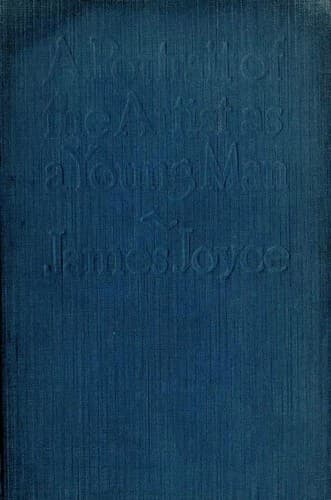
A Portrait of the Artist as a Young ManJoyce, James
General
A Portrait of the Artist as a Young Man
Joyce, James
Artists -- Fiction; Autobiographical fiction; Bildungsromans; Dublin (Ireland) -- Fiction; Young men -- Fiction
—My dear man, said Cranly urbanely, you are incapable, do you know,
absolutely incapable of thinking.
—But do you know, Temple went on, what I think of you and of myself
compared together?
—Out with it, Temple! the stout student cried from the steps. Get it
out in bits!
Temple turned right and left, making sudden feeble gestures as he
spoke.
—I’m a ballocks, he said, shaking his head in despair. I am and I know
I am. And I admit it that I am.
Dixon patted him lightly on the shoulder and said mildly:
—And it does you every credit, Temple.
—But he, Temple said, pointing to Cranly, he is a ballocks, too, like
me. Only he doesn’t know it. And that’s the only difference I see.
A burst of laughter covered his words. But he turned again to Stephen
and said with a sudden eagerness:
—That word is a most interesting word. That’s the only English dual
number. Did you know?
—Is it? Stephen said vaguely.
He was watching Cranly’s firm-featured suffering face, lit up now by a
smile of false patience. The gross name had passed over it like foul
water poured over an old stone image, patient of injuries; and, as he
watched him, he saw him raise his hat in salute and uncover the black
hair that stood stiffly from his forehead like an iron crown.
She passed out from the porch of the library and bowed across Stephen
in reply to Cranly’s greeting. He also? Was there not a slight flush on
Cranly’s cheek? Or had it come forth at Temple’s words? The light had
waned. He could not see.
Did that explain his friend’s listless silence, his harsh comments, the
sudden intrusions of rude speech with which he had shattered so often
Stephen’s ardent wayward confessions? Stephen had forgiven freely for
he had found this rudeness also in himself. And he remembered an
evening when he had dismounted from a borrowed creaking bicycle to pray
to God in a wood near Malahide. He had lifted up his arms and spoken in
ecstasy to the sombre nave of the trees, knowing that he stood on holy
ground and in a holy hour. And when two constabulary men had come into
sight round a bend in the gloomy road he had broken off his prayer to
whistle loudly an air from the last pantomime.
He began to beat the frayed end of his ashplant against the base of a
pillar. Had Cranly not heard him? Yet he could wait. The talk about him
ceased for a moment and a soft hiss fell again from a window above. But
no other sound was in the air and the swallows whose flight he had
followed with idle eyes were sleeping.
She had passed through the dusk. And therefore the air was silent save
for one soft hiss that fell. And therefore the tongues about him had
ceased their babble. Darkness was falling.
Darkness falls from the air.
A trembling joy, lambent as a faint light, played like a fairy host
around him. But why? Her passage through the darkening air or the verse
with its black vowels and its opening sound, rich and lutelike?
Public-domain text, read in full here on John Shaqi.
Reviews
Reviews
No reviews yet
Be the first to share your thoughts on this work.
Elsewhere in the archive
Join the Discussion
Join the discussion
Sign in to leave a comment or review.
Sign InorCreate an account