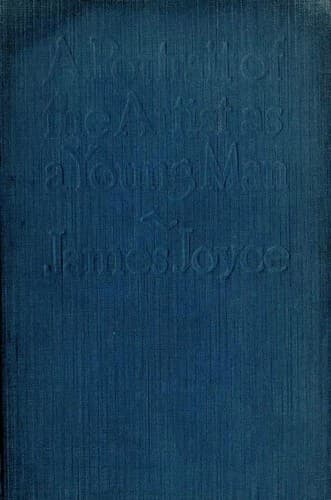
A Portrait of the Artist as a Young ManJoyce, James
General
A Portrait of the Artist as a Young Man
Joyce, James
Artists -- Fiction; Autobiographical fiction; Bildungsromans; Dublin (Ireland) -- Fiction; Young men -- Fiction
—A medical student, an oarsman, a tenor, an amateur actor, a shouting
politician, a small landlord, a small investor, a drinker, a good
fellow, a storyteller, somebody’s secretary, something in a distillery,
a taxgatherer, a bankrupt and at present a praiser of his own past.
Cranly laughed, tightening his grip on Stephen’s arm, and said:
—The distillery is damn good.
—Is there anything else you want to know? Stephen asked.
—Are you in good circumstances at present?
—Do I look it? Stephen asked bluntly.
—So then, Cranly went on musingly, you were born in the lap of luxury.
He used the phrase broadly and loudly as he often used technical
expressions as if he wished his hearer to understand that they were
used by him without conviction.
—Your mother must have gone through a good deal of suffering, he said
then. Would you not try to save her from suffering more even if... or
would you?
—If I could, Stephen said, that would cost me very little.
—Then do so, Cranly said. Do as she wishes you to do. What is it for
you? You disbelieve in it. It is a form: nothing else. And you will set
her mind at rest.
He ceased and, as Stephen did not reply, remained silent. Then, as if
giving utterance to the process of his own thought, he said:
—Whatever else is unsure in this stinking dunghill of a world a
mother’s love is not. Your mother brings you into the world, carries
you first in her body. What do we know about what she feels? But
whatever she feels, it, at least, must be real. It must be. What are
our ideas or ambitions? Play. Ideas! Why, that bloody bleating goat
Temple has ideas. MacCann has ideas too. Every jackass going the roads
thinks he has ideas.
Stephen, who had been listening to the unspoken speech behind the
words, said with assumed carelessness:
—Pascal, if I remember rightly, would not suffer his mother to kiss him
as he feared the contact of her sex.
—Pascal was a pig, said Cranly.
—Aloysius Gonzaga, I think, was of the same mind, Stephen said.
—And he was another pig then, said Cranly.
—The church calls him a saint, Stephen objected.
—I don’t care a flaming damn what anyone calls him, Cranly said rudely
and flatly. I call him a pig.
Stephen, preparing the words neatly in his mind, continued:
—Jesus, too, seems to have treated his mother with scant courtesy in
public but Suarez, a jesuit theologian and Spanish gentleman, has
apologised for him.
—Did the idea ever occur to you, Cranly asked, that Jesus was not what
he pretended to be?
—The first person to whom that idea occurred, Stephen answered, was
Jesus himself.
—I mean, Cranly said, hardening in his speech, did the idea ever occur
to you that he was himself a conscious hypocrite, what he called the
jews of his time, a whited sepulchre? Or, to put it more plainly, that
he was a blackguard?
—That idea never occurred to me, Stephen answered. But I am curious to
know are you trying to make a convert of me or a pervert of yourself?
Public-domain text, read in full here on John Shaqi.
Reviews
Reviews
No reviews yet
Be the first to share your thoughts on this work.
Elsewhere in the archive
Join the Discussion
Join the discussion
Sign in to leave a comment or review.
Sign InorCreate an account