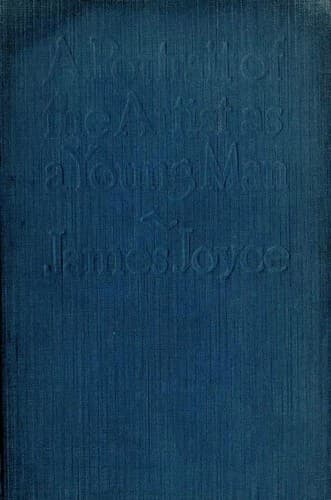
A Portrait of the Artist as a Young ManJoyce, James
General
A Portrait of the Artist as a Young Man
Joyce, James
Artists -- Fiction; Autobiographical fiction; Bildungsromans; Dublin (Ireland) -- Fiction; Young men -- Fiction
As he watched this swaying form and tried to read for himself the
legend of the priest’s mocking smile there came into Stephen’s memory a
saying which he had heard from his father before he had been sent to
Clongowes, that you could always tell a jesuit by the style of his
clothes. At the same moment he thought he saw a likeness between his
father’s mind and that of this smiling welldressed priest: and he was
aware of some desecration of the priest’s office or of the vestry
itself whose silence was now routed by loud talk and joking and its air
pungent with the smells of the gasjets and the grease.
While his forehead was being wrinkled and his jaws painted black and
blue by the elderly man he listened distractedly to the voice of the
plump young jesuit which bade him speak up and make his points clearly.
He could hear the band playing _The Lily of Killarney_ and knew that in
a few moments the curtain would go up. He felt no stage fright but the
thought of the part he had to play humiliated him. A remembrance of
some of his lines made a sudden flush rise to his painted cheeks. He
saw her serious alluring eyes watching him from among the audience and
their image at once swept away his scruples, leaving his will compact.
Another nature seemed to have been lent him: the infection of the
excitement and youth about him entered into and transformed his moody
mistrustfulness. For one rare moment he seemed to be clothed in the
real apparel of boyhood: and, as he stood in the wings among the other
players, he shared the common mirth amid which the drop scene was
hauled upwards by two ablebodied priests with violent jerks and all
awry.
A few moments after he found himself on the stage amid the garish gas
and the dim scenery, acting before the innumerable faces of the void.
It surprised him to see that the play which he had known at rehearsals
for a disjointed lifeless thing had suddenly assumed a life of its own.
It seemed now to play itself, he and his fellow actors aiding it with
their parts. When the curtain fell on the last scene he heard the void
filled with applause and, through a rift in a side scene, saw the
simple body before which he had acted magically deformed, the void of
faces breaking at all points and falling asunder into busy groups.
Public-domain text, read in full here on John Shaqi.
Reviews
Reviews
No reviews yet
Be the first to share your thoughts on this work.
Elsewhere in the archive
Join the Discussion
Join the discussion
Sign in to leave a comment or review.
Sign InorCreate an account