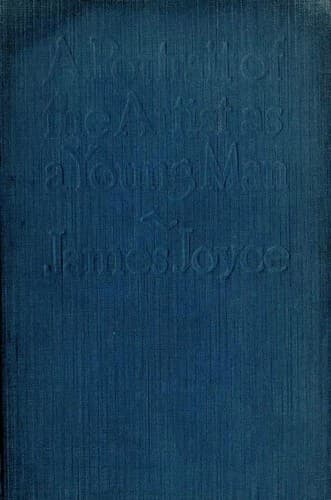
A Portrait of the Artist as a Young ManJoyce, James
General
A Portrait of the Artist as a Young Man
Joyce, James
Artists -- Fiction; Autobiographical fiction; Bildungsromans; Dublin (Ireland) -- Fiction; Young men -- Fiction
The memory of his childhood suddenly grew dim. He tried to call forth
some of its vivid moments but could not. He recalled only names. Dante,
Parnell, Clane, Clongowes. A little boy had been taught geography by an
old woman who kept two brushes in her wardrobe. Then he had been sent
away from home to a college, he had made his first communion and eaten
slim jim out of his cricketcap and watched the firelight leaping and
dancing on the wall of a little bedroom in the infirmary and dreamed of
being dead, of mass being said for him by the rector in a black and
gold cope, of being buried then in the little graveyard of the
community off the main avenue of limes. But he had not died then.
Parnell had died. There had been no mass for the dead in the chapel and
no procession. He had not died but he had faded out like a film in the
sun. He had been lost or had wandered out of existence for he no longer
existed. How strange to think of him passing out of existence in such a
way, not by death but by fading out in the sun or by being lost and
forgotten somewhere in the universe! It was strange to see his small
body appear again for a moment: a little boy in a grey belted suit. His
hands were in his sidepockets and his trousers were tucked in at the
knees by elastic bands.
On the evening of the day on which the property was sold Stephen
followed his father meekly about the city from bar to bar. To the
sellers in the market, to the barmen and barmaids, to the beggars who
importuned him for a lob Mr Dedalus told the same tale, that he was an
old Corkonian, that he had been trying for thirty years to get rid of
his Cork accent up in Dublin and that Peter Pickackafax beside him was
his eldest son but that he was only a Dublin jackeen.
They had set out early in the morning from Newcombe’s coffeehouse,
where Mr Dedalus’ cup had rattled noisily against its saucer, and
Stephen had tried to cover that shameful sign of his father’s drinking
bout of the night before by moving his chair and coughing. One
humiliation had succeeded another—the false smiles of the market
sellers, the curvetings and oglings of the barmaids with whom his
father flirted, the compliments and encouraging words of his father’s
friends. They had told him that he had a great look of his grandfather
and Mr Dedalus had agreed that he was an ugly likeness. They had
unearthed traces of a Cork accent in his speech and made him admit that
the Lee was a much finer river than the Liffey. One of them, in order
to put his Latin to the proof, had made him translate short passages
from Dilectus and asked him whether it was correct to say: _Tempora
mutantur nos et mutamur in illis_ or _Tempora mutantur et nos mutamur
in illis._ Another, a brisk old man, whom Mr Dedalus called Johnny
Cashman, had covered him with confusion by asking him to say which were
prettier, the Dublin girls or the Cork girls.
Public-domain text, read in full here on John Shaqi.
Reviews
Reviews
No reviews yet
Be the first to share your thoughts on this work.
Elsewhere in the archive
Join the Discussion
Join the discussion
Sign in to leave a comment or review.
Sign InorCreate an account