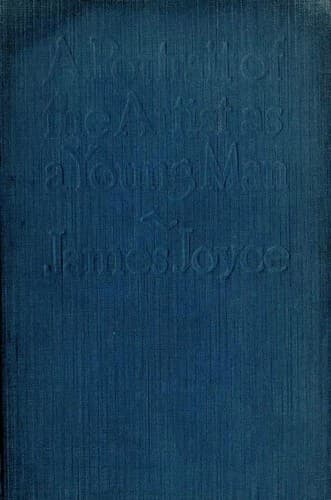
A Portrait of the Artist as a Young ManJoyce, James
General
A Portrait of the Artist as a Young Man
Joyce, James
Artists -- Fiction; Autobiographical fiction; Bildungsromans; Dublin (Ireland) -- Fiction; Young men -- Fiction
_ —O my God!—
—O my God!—
—I am heartily sorry—
—for having offended Thee—
—and I detest my sins—
—above every other evil—
—because they displease Thee, my God—
—Who art so deserving—
—of all my love—
—of all my love—
—and I firmly purpose—
—by Thy holy grace—
—by Thy holy grace—
—never more to offend Thee—
—and to amend my life—
—and to amend my life—_
He went up to his room after dinner in order to be alone with his soul,
and at every step his soul seemed to sigh; at every step his soul
mounted with his feet, sighing in the ascent, through a region of
viscid gloom.
He halted on the landing before the door and then, grasping the
porcelain knob, opened the door quickly. He waited in fear, his soul
pining within him, praying silently that death might not touch his brow
as he passed over the threshold, that the fiends that inhabit darkness
might not be given power over him. He waited still at the threshold as
at the entrance to some dark cave. Faces were there; eyes: they waited
and watched.
—We knew perfectly well of course that though it was bound to come to
the light he would find considerable difficulty in endeavouring to try
to induce himself to try to endeavour to ascertain the spiritual
plenipotentiary and so we knew of course perfectly well—
Murmuring faces waited and watched; murmurous voices filled the dark
shell of the cave. He feared intensely in spirit and in flesh but,
raising his head bravely, he strode into the room firmly. A doorway, a
room, the same room, same window. He told himself calmly that those
words had absolutely no sense which had seemed to rise murmurously from
the dark. He told himself that it was simply his room with the door
open.
He closed the door and, walking swiftly to the bed, knelt beside it and
covered his face with his hands. His hands were cold and damp and his
limbs ached with chill. Bodily unrest and chill and weariness beset
him, routing his thoughts. Why was he kneeling there like a child
saying his evening prayers? To be alone with his soul, to examine his
conscience, to meet his sins face to face, to recall their times and
manners and circumstances, to weep over them. He could not weep. He
could not summon them to his memory. He felt only an ache of soul and
body, his whole being, memory, will, understanding, flesh, benumbed and
weary.
Public-domain text, read in full here on John Shaqi.
Reviews
Reviews
No reviews yet
Be the first to share your thoughts on this work.
Elsewhere in the archive
Join the Discussion
Join the discussion
Sign in to leave a comment or review.
Sign InorCreate an account