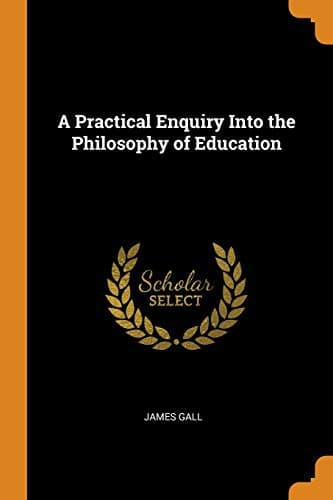
A Practical Enquiry into the Philosophy of EducationGall, James
Philosophy
A Practical Enquiry into the Philosophy of Education
Gall, James
Education
In teaching the alphabet to children, the principle of individuation is
indispensable; and its neglect has been productive of serious and
permanent mischief. A child of good capacity, by a proper attention to
this principle, will, with pleasure and ease, learn the names and forms
of the letters, with the labour of only a few hours;[15] while, by
neglecting the principle, the same child would, after years of
irritation and weariness, be still found ignorant of its alphabet. The
overlooking of the principle at this period has done an immense deal of
injury to the cause of education. It has, at the very starting post in
the race of improvement, quenched and destroyed all the real, as well as
the imaginary delights of learning and knowledge. It has given the tyro
such an erroneous but overwhelming impression of the difficulties and
miseries which he must endure in his future advance, that the disgust
then created has often so interwoven itself with his every feeling, that
education has during life appeared to him the natural and necessary
enemy to every kind of enjoyment.
It used to be common, and the practice may still we believe be found
lingering among some of the lovers of antiquity, to make a child
commence at the letter A, and proceed along the alphabet without
stopping till he arrived at Z; and this lesson not unfrequently included
both the alphabets of capitals and small letters. Now the cruelty of
such an exercise with a child will at once be apparent, if we shall only
change its form. If a teacher were to read over to an infant twice a-day
a whole page or paragraph _without stopping_ of Caesar or Cicero in
Latin, and demand that on hearing it he shall learn it, we could at once
judge of the difficulty, and the feelings of a volatile mind chained to
the constant and daily repetition of such a task; and if this exercise
were termed its "education," we can easily conceive the amount of
affection that the child would learn to cherish towards it. Now this is
really no exaggerated illustration of the matter in hand, for in both
cases the principle of individuation, so carefully guarded and enforced
by Nature, is equally outraged; and it is only where, by some means or
other, a remedy for the evil accidentally occurs, that the result in the
case of the alphabet, is not exactly the same as it would have been in
the case of the classics above supposed. The writer once saw in a Sunday
school, where the children were taught twice each Sabbath, a class in
which some of the children had attended for upwards of two years, and
were still in their alphabet; and if the same mode had been pursued,
there is little doubt that they would have been in it yet.
Public-domain text, read in full here on John Shaqi.
Reviews
Reviews
No reviews yet
Be the first to share your thoughts on this work.
Elsewhere in the archive
Join the Discussion
Join the discussion
Sign in to leave a comment or review.
Sign InorCreate an account