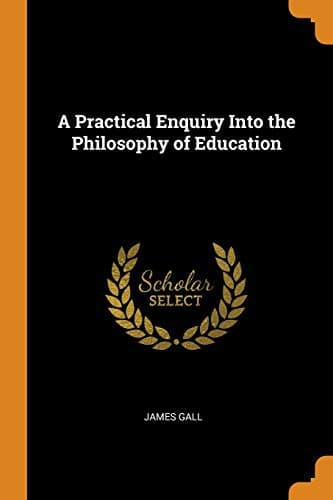
A Practical Enquiry into the Philosophy of EducationGall, James
Philosophy
A Practical Enquiry into the Philosophy of Education
Gall, James
Education
This is but one of a thousand examples that might be given, of the evils
arising from the non-application of knowledge in reading, and which are
applicable, not to children merely, but also to adults. The drawing and
applying of lessons, the exercise which we are here recommending, has
been found a valuable remedy for this defect in ordinary reading. The
object of the teacher by its use, is to accomplish in the pupil by
_reading_, what we have shewn Nature so frequently does by
_observation_;--that is, to train the child to apply for his own use, or
the use of others, those truths which he acquires from his _book_, in
the same way that he does those which he derives from _experience_. To
illustrate this, we shall instance a few cases of every day occurrence,
in which the question, "What does this teach you?" when supplemented to
the fact communicated, will almost invariably answer the purpose
desired, whether the truth from which the lesson is to be drawn, has
been received by observation, by oral instruction, or by reading.
When an observing well-disposed child sees a school-fellow praised and
rewarded for being obliging and kind to the aged or the poor, there is
formed in the mind of that child, more or less distinctly, a resolution
to follow the example on the first opportunity. Here is the fact and the
lesson, with the application in prospect. This whole feeling may be
faint and evanescent, but it is real; and it only wants the cultivating
hand of the teacher to arrest it, and to render it permanent.
Accordingly, if on the child hearing the praise given to his companion
for being kind and obliging to the poor, he had at the time been asked,
"What does that teach you?" the lesson suggested by Nature would
instantly have assumed a tangible form; and in communicating the answer
to the teacher, both the truth and the lesson would have been brought
more distinctly before the mind, and the reply, "I should be kind and
obliging to the poor," would tend to fix the duty on the memory, and
would be a good preparation for putting it in practice when the next
occasion should occur.
Again, if another thoughtful and well disposed child sees a companion
severely punished for telling a lie, the question, "What does that teach
me?" is in some shape or degree formed in his mind, and his resolution,
however faint, is taken to avoid that sin in future. This, it is
obvious, is nothing more than a practical answer to the above question,
forced upon the child by the directness of the circumstances, but which
would not have so readily made its appearance, or produced its effect,
in cases of a less obtrusive kind, or in one of more remote application;
and every person must see, that the beneficial effects desired would
have been more definite, more effectual, and much more permanent, had
this faint indication of Nature's intention been followed up by orally
asking the question at the child, and requiring him audibly to return an
answer.
Public-domain text, read in full here on John Shaqi.
Reviews
Reviews
No reviews yet
Be the first to share your thoughts on this work.
Elsewhere in the archive
Join the Discussion
Join the discussion
Sign in to leave a comment or review.
Sign InorCreate an account