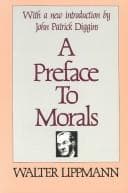
The trouble with the moralists is in the moralists themselves: they
have failed to understand their times. They [p317] think they are
dealing with a generation that refuses to believe in ancient authority.
They are, in fact, dealing with a generation that cannot believe in
it. They think they are confronted with men who have an irrational
preference for immorality, whereas the men and women about them are
ridden by doubts because they do not know what they prefer, nor why.
The moralists fancy that they are standing upon the rock of eternal
truth, surveying the chaos about them. They are greatly mistaken.
Nothing in the modern world is more chaotic—not its politics, its
business, or its sexual relations—than the minds of orthodox moralists
who suppose that the problem of morals is somehow to find a way of
reinforcing the sanctions which are dissolving. How can we, they say in
effect, find formulas and rhetoric potent enough to make men behave?
How can we revive in them that love and fear of God, that sense of the
creature’s dependence upon his creator, that obedience to the commands
of a heavenly king, which once gave force and effect to the moral code?
They have misconceived the moral problem, and therefore they
misconceive the function of the moralist. An authoritative code of
morals has force and effect when it expresses the settled customs of
a stable society: the pharisee can impose upon the minority only such
conventions as the majority find appropriate and necessary. But when
customs are unsettled, as they are in the modern world, by continual
change in the circumstances of life, the pharisee is helpless. He
cannot command with authority because his commands no longer imply the
usages of the community: they express the prejudices of the moralist
rather than the practices of men. When that [p318] happens, it is
presumptuous to issue moral commandments, for in fact nobody has
authority to command. It is useless to command when nobody has the
disposition to obey. It is futile when nobody really knows exactly
what to command. In such societies, wherever they have appeared among
civilized men, the moralist has ceased to be an administrator of usages
and has had to become an interpreter of human needs. For ages when
custom is unsettled are necessarily ages of prophecy. The moralist
cannot teach what is revealed; he must reveal what can be taught. He
has to seek insight rather than to preach.
Public-domain text, read in full here on John Shaqi.
Reviews
Reviews
No reviews yet
Be the first to share your thoughts on this work.
Elsewhere in the archive
Join the Discussion
Join the discussion
Sign in to leave a comment or review.
Sign InorCreate an account