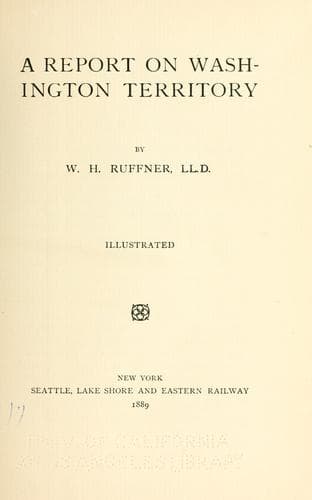
A Report on Washington TerritoryRuffner, William Henry
History
A Report on Washington Territory
Ruffner, William Henry
Washington (State)
Lincoln County, through the length of which the road must pass, is
universally admitted to be among the best agricultural counties on the
plateau. It is also settling up rapidly, and has become a large producer
of wheat, even at the disadvantage of a long haul in wagons. Mr. Curtis,
who buys much of the Lincoln County wheat for his mill at Spokane Falls,
says that the average yield of wheat is twenty-five bushels per acre,
though in 1886 (the year of failure) it fell to sixteen and one-half
bushels. Captain McGowan, of Lincoln County, also gave twenty-five
bushels as the average crop, and said this would hold good for the whole
period since the settlement of the county, including the bad year 1886.
[Sidenote: Spokane County.]
[Sidenote: Price of farming lands.]
By reference of the official map showing the wheat areas, it will be
seen that the Seattle railway passes through the middle of these areas
in both Lincoln and Spokane counties. The testimony was entirely
favorable in regard to horticultural and pomological products, as well
as to the agricultural, in the strict sense. The population of the three
counties, Douglas, Lincoln and Spokane, was put by Governor Semple at
nearly 18,000; about 17,000 of which was in Lincoln and Spokane. Much
land has been bought with a view to settlement as well as speculation,
and this would be occupied and cultivated _pari passu_ with the progress
of the railroad, and there yet remains much good land which can be
bought at low prices, say from one dollar to five dollars an acre, and
will attract settlers. Farming lands here will have market at the mines
north of the Columbia River, at Spokane Falls, where there will be a
large city, as well as large mills, and at Seattle, where there will be
a large demand not only for the city, but for shipping.
[Sidenote: Tonnage.]
No reliable estimates can now be made as to what business this Great
Bend country will furnish ten to twenty years hence. We have only this
to guide us, namely, that the part of the plateau which lies south of
the Northern Pacific Railroad now furnishes 400,000 tons of wheat for
transportation annually, besides other freight and passengers; and it
has not reached one-half of its producing capacity. Mr. Mohr estimates
the income from mail and express as one-fifth the income from freight,
and passenger fares as one-quarter of the whole amount from tonnage.
Though the country lying north of the Northern Pacific Railroad is much
larger in area than that which lies south of it, it may not average as
well, and cannot all be controlled by one railroad; but it will
certainly furnish large tonnage; much more than is common in
agricultural regions.
At present the product of wheat in this region is estimated at 100,000
bushels, but this amount would probably be doubled the first year after
the railroad comes, and rapidly increased afterward. Much of the mining
business already crosses this territory, and will, no doubt, greatly
increase.
Public-domain text, read in full here on John Shaqi.
Reviews
Reviews
No reviews yet
Be the first to share your thoughts on this work.
Elsewhere in the archive
Join the Discussion
Join the discussion
Sign in to leave a comment or review.
Sign InorCreate an account