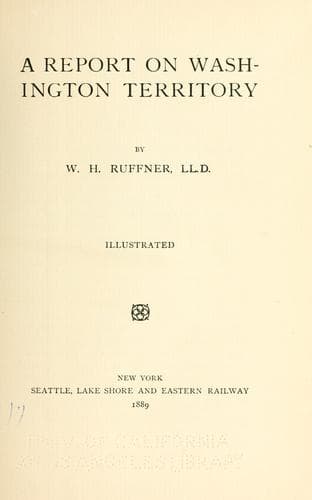
A Report on Washington TerritoryRuffner, William Henry
History
A Report on Washington Territory
Ruffner, William Henry
Washington (State)
The minimum of cost is reached when the seams are of good thickness and
comparatively free from slate, and can be entered on the end by a level
entry above water and be mined upward; to which may be added natural
pitch enough in the seams for the coal to be self-loading; that is, to
run by gravity from the upper gangways to the cars on the main entry.
And to these conditions may be added a number of different parallel
seams close together with their bluff ends all coming up to a line in
the most convenient way for entry and delivery. It is rarely the case
that such an assemblage of favorable conditions can be found, and where
they exist the successful future of the property is absolutely assured.
[Sidenote: Cost at Gilman Mines.]
In my opinion, the Gilman coal seams combine all the advantages above
mentioned, and if allowed ordinary rates of transportation, can always
be mined at a profit. As long as the Newcastle seams could be worked
above water-level the average cost per ton was $1.10, but they never had
the same advantages there as at Gilman, and most of their mining has
been downward. $1.00 per ton is certainly high enough for Gilman after
the entries are driven in sufficiently for large operations. If Mr.
Whitworth succeeds in putting out the coal at $1.25 for the first six
months, as he thinks he can, there need be no fear as to the future.
[Sidenote: Prices of coal.]
The selling price of coal on Puget Sound has ranged from $3.00 to $5.00
a long ton in former years, averaging $4.00--the price being the same
for the product of all the different mines. Mr. Whitworth reports the
price this winter at $6.50 a ton for all (including Newcastle), except
Cedar River, which is $5.00. The distances from Puget Sound to Portland
and to San Francisco, the principal markets, are: to San Francisco,
between 800 and 900 miles by water; to Portland, 450 by water, and 150
by rail. There is now rail connection all the way to San Francisco. The
average cost of sending coal to San Francisco, either from Puget Sound
or Vancouver's Island, is $2.00. The usual price in San Francisco and
Portland has been from $4.25 to $6.00 for coarse, and from $2.75 to
$3.75 for small. On the 1st of February, 1888, the cargo price in San
Francisco was--for Coos Bay coal, $9.50; Seattle coal, $10; South
Prairie, $10; Nanaimo (domestic), $10; Nanaimo (steam), $12; Lehigh,
$18; Cumberland, $12.
These figures make it evident that a good margin of profit may be
calculated on from the Gilman coal. Mr. Whitworth will not be able to
get his bunkers up until he has his road in operation to the mines; but,
with temporary chutes, he can load 100 tons a day from the time the road
opens, say March 15th. In six weeks after beginning he expects to
increase to 300 tons a day, and one month later he can make the output
600 tons a day. As the headings are driven in the product can be
increased to almost any desired amount.
Public-domain text, read in full here on John Shaqi.
Reviews
Reviews
No reviews yet
Be the first to share your thoughts on this work.
Elsewhere in the archive
Join the Discussion
Join the discussion
Sign in to leave a comment or review.
Sign InorCreate an account