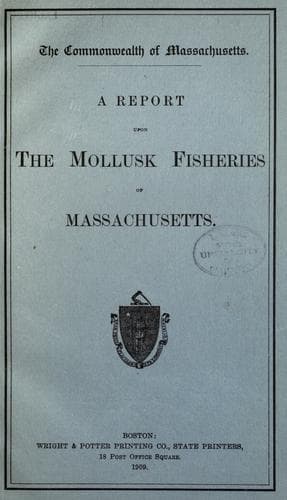
A Report upon the Mollusk Fisheries of MassachusettsMassachusetts. Commissioners on Fisheries and Game
Science
A Report upon the Mollusk Fisheries of Massachusetts
Massachusetts. Commissioners on Fisheries and Game
Shellfish fisheries -- Massachusetts
In 1878 a peculiar act was passed, making it unlawful for any person
to remove oysters from any grant, even his own, between the hours
of sunset and sunrise. This act was necessary for the protection of
the oyster planters, by preventing the stealing of oysters from the
grant at night. Various efforts had been made to protect grants from
such attacks, but the extreme difficulty of detection was always an
insuperable obstacle to proper enforcement, and it was deemed expedient
to prohibit all fishing at night. That this problem had become an
important one is shown by the title of the law, which was styled
"An act for the better protection of the oyster fisheries in this
commonwealth."
In 1884 an important act was passed, enlarging the limits of that
territory which might lawfully be used for the cultivation of oysters.
Practically all communal waters outside the jurisdiction of adjacent
land owners was thrown open for oyster grants.
In 1885 the institution of a public hearing was inaugurated. This was a
concession to the hostile quahaug element, and allowed the public the
opportunity of protesting against the granting of territory for oyster
culture; nevertheless, the final power really remained in the hands of
the selectmen. A further concession to this element was the law which
called for the revoking of grants within two years if unimproved. The
interests of the oystermen were also kept in sight, and legislation
passed which was designed to protect grants still more from the
depredations of outsiders. Provision was likewise made for the proper
enforcement of these laws, and the penalties attached were increased.
In 1886 an act was passed which was designed to do away with all
possible outside monopoly. The danger of organized capital acquiring
control of a large tract and excluding small individual planters had
become apparent, and this means was taken to guard against it. The act
prohibited the transfer of grants in any township to any person not a
citizen of that township; thus, if any monopoly did exist it would be
restricted to only one township. The limits during which fishing on
grants might be carried on was lengthened two hours, so that it read
from "one hour before sunrise to one hour after sunset."
In 1892 the town of Yarmouth obtained a law requiring a permit for
citizens to take oysters from native beds, not exceeding 2 bushels per
week, from September 1 to June 1. This is now the only town in the
Commonwealth to require such a permit from citizens.
Public-domain text, read in full here on John Shaqi.
Reviews
Reviews
No reviews yet
Be the first to share your thoughts on this work.
Elsewhere in the archive
Join the Discussion
Join the discussion
Sign in to leave a comment or review.
Sign InorCreate an account