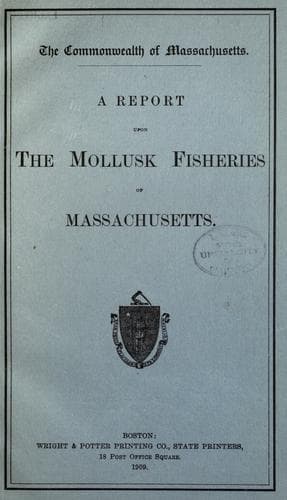
A Report upon the Mollusk Fisheries of MassachusettsMassachusetts. Commissioners on Fisheries and Game
Science
A Report upon the Mollusk Fisheries of Massachusetts
Massachusetts. Commissioners on Fisheries and Game
Shellfish fisheries -- Massachusetts
The statistical returns of the Bourne oystermen show that only 42
grants comprising 100 acres are worked. Of this 83 acres is hard bottom
suitable for oyster raising while the remaining 17 acres is mostly soft
mud.
Capital invested, $24,448
Power boats, 3
Value of power boats, $3,000
Sail boats, 8
Value of sail boats, $1,900
Dories and skiffs, 29
Value of dories and skiffs, $615
Implements:--
Dredges, 99
Tongs, 38
Value of implements, $483
Value of shore property, $150
Value of bedded oysters, $18,300
Twenty-one men make a living from the industry. The production for
the year ending Aug. 1, 1907, amounted to 2,100 bushels of marketable
oysters, valued at $4,100, and 23,000 bushels of "seed," worth $15,000.
The methods employed in oyster culture here are similar to those in use
at Wareham. Thousands of bushels of shells, preferably those of the
scallop, are strewn over the bottom to collect the set, which is then
taken up and transferred to the proper grant or shipped for sale. The
two great enemies of the oyster, the borer or drill, and the starfish,
flourish here. The borer seems more destructive in those sections which
are comparatively sheltered, the starfish in more exposed localities.
The history of the industry is one of picturesque variety. The
beginnings of the industry were bright with promise; the sudden growth
which followed was spectacular but erratic; and the difficulties
which soon arose plunged it into complications from which it emerged
much shattered and greatly declined. Originally there were three good
natural beds,--in Monument River, Barlow's River and Red Brook harbor,
respectively. These beds long supplied all the oysters produced,
and when in 1834 they began to be depleted, legislation was enacted
regulating them until 1863, when the town surveyed a number of grants
in the Monument River, each with an average area of 1½ to 10 acres,
and allowed one of these grants to every citizen desiring it, on the
payment of $2.50. These old beds still linger as rather uncertain
assets of the communal wealth. The Monument River grounds still supply
a fairly large harvest, the Barlow River has declined much more, while
the Cataumet beds are nearly extinct.
Public-domain text, read in full here on John Shaqi.
Reviews
Reviews
No reviews yet
Be the first to share your thoughts on this work.
Elsewhere in the archive
Join the Discussion
Join the discussion
Sign in to leave a comment or review.
Sign InorCreate an account