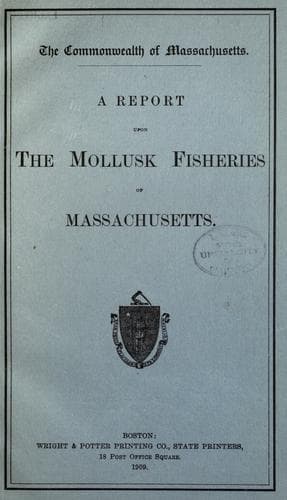
A Report upon the Mollusk Fisheries of MassachusettsMassachusetts. Commissioners on Fisheries and Game
Science
A Report upon the Mollusk Fisheries of Massachusetts
Massachusetts. Commissioners on Fisheries and Game
Shellfish fisheries -- Massachusetts
III. _The Development of Inland Markets._--The consumption of clams
for food in the coast towns continued throughout the rise and gradual
decline of the bait industry, but the creation of inland markets did
not begin to be an important factor until 1875. It was about this time
that the clam came to be generally looked upon throughout the State
as an article of food, and consequently an important industry was
gradually evolved to meet this growing demand. This step marked the
beginning of the extensive fishery of the present day.
The mistaken policy of the average shellfish community, which
regarded clam grounds as natural gardens of inexhaustible fertility,
still persisted even after the fallacy of this policy had long
proved apparent through the depletion of extensive tracts. The same
ill-advised methods were pursued to the ultimate ruination of much
valuable territory. All wise regard for the future was overshadowed
by the immediate needs of the present; local legislation fostered the
evil; State legislation was conspicuous by its absence; and, left to
the mercy of unsystematic overdigging, these natural resources rapidly
wasted away.
The disastrous tendencies which have lurked in the ruling policy of
the clam fishery have been shown in the rise and fall of the industry
in certain localities. Forty years ago Duxbury and Plymouth ranked
as the greatest clam towns of the coast. Their supply has long since
become insignificant. Newburyport and Ipswich have become the chief
producers of the State clam harvest; but Essex and Gloucester, in the
same fertile regions, have greatly declined, and the industry at Rowley
has become nearly extinct. In the Fall River district the digging of
small seed clams for food has brought the fishery to the verge of ruin.
The few resources of Buzzards Bay have become nearly exhausted, while
on Cape Cod the industry has shown here and there a temporary increase,
overshadowed by a far more extensive decline, such as at Chatham.
Furthermore, the sewage contamination of coast waters in the harbors of
Boston and several other large cities have closed extensive regions for
the production of food.
Public-domain text, read in full here on John Shaqi.
Reviews
Reviews
No reviews yet
Be the first to share your thoughts on this work.
Elsewhere in the archive
Join the Discussion
Join the discussion
Sign in to leave a comment or review.
Sign InorCreate an account