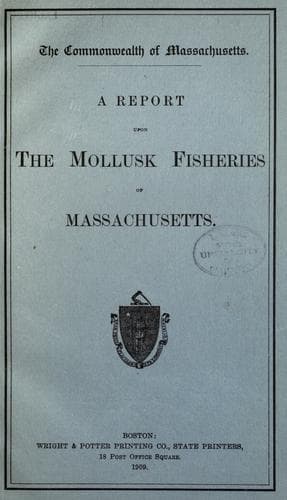
A Report upon the Mollusk Fisheries of MassachusettsMassachusetts. Commissioners on Fisheries and Game
Science
A Report upon the Mollusk Fisheries of Massachusetts
Massachusetts. Commissioners on Fisheries and Game
Shellfish fisheries -- Massachusetts
_Price._--The price of clams is fairly constant, varying but little
in summer and winter. Naturally, this seems curious, when winter and
summer clamming are compared. The production in winter is much smaller
than in summer, which is due to (1) fewer clammers, because of the
severe work in cold weather; (2) less working days, as the clammer
is often unable to dig for weeks, and even months, and also cannot
work early or late tides, as in summer. In spite of this diminution
of supply, the winter price is practically no higher. This is due to
a smaller demand in winter, as well as to the influx of the Maine
clams at this season. In summer there is an increased demand for
clams, caused by the arrival of the summer people at the seashore; and
large quantities of this shellfish are used by hotels, cottages, etc.
This increase in demand is enough to offset the increase in supply,
resulting in a stationary price.
The price varies as to the quality of the clams, whether soaked or
unsoaked, small or large, good or poor looking shells, and fresh or
stale. The average price as received by the clammer for clams in the
shell is 75 cents per bushel; shucked clams, when soaked, 45-50 cents
per gallon.
_Arrangement of Towns._
Owing to the peculiarities of the different localities, it has been
impossible to satisfactorily arrange the towns alphabetically.
Therefore, in order to present local comparisons, they have been
arranged in geographical order, starting at the northern boundary of
the State.
_Salisbury._
Salisbury, the most northerly town in the State, has a good clam
territory, very similar to that of Newburyport, though much smaller in
area.
Almost all the clam ground, and practically all the very good digging,
is comprised in a single flat, which extends along the northerly bank
of the Merrimac for nearly 2 miles. This flat is about 900 feet wide,
on an average, and has a total area of 216 acres. On the eastern end,
and skirting the channel, it is sandy; but for the most part it is mud
throughout, varying from a hard, smooth surface in the middle portion
to a soft, scummy soil on the west.
Public-domain text, read in full here on John Shaqi.
Reviews
Reviews
No reviews yet
Be the first to share your thoughts on this work.
Elsewhere in the archive
Join the Discussion
Join the discussion
Sign in to leave a comment or review.
Sign InorCreate an account