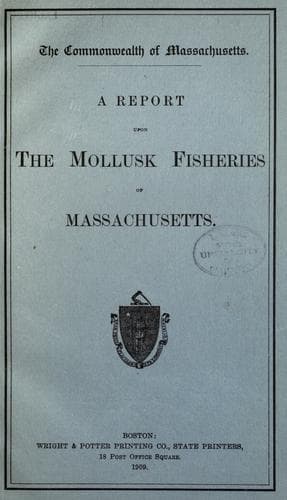
A Report upon the Mollusk Fisheries of MassachusettsMassachusetts. Commissioners on Fisheries and Game
Science
A Report upon the Mollusk Fisheries of Massachusetts
Massachusetts. Commissioners on Fisheries and Game
Shellfish fisheries -- Massachusetts
The third section comprises that portion of the clam flat area
bordering the coast of Pleasant Bay which crosses the town boundaries
on the southeast. Here clams are rather scarce, though dug
occasionally. This section is economically the least important of the
four.
The fourth section extends along the western coast, on a belt of sand
bars well out in Cape Cod Bay. Clams are found on a strip about a
quarter of a mile in width, and lying over half a mile from shore. This
is a very exposed location. Billingsgate Point, projecting out from
the Wellfleet coast, offers some protection from northwest winds, and
the hills of the Cape break the force of the easterly gales; but the
full force of storms from the west and southwest sweeps these bars, and
would seem to render them unsuitable for the growth of clams. Clams are
here, however, in considerable numbers, though not so numerous as three
or four years ago, and are dug to some extent.
The greater part of the digging is done by intermittent clammers, who
obtain perhaps 2½ bushels per day. No permits are required, as there
are no town by-laws regulating the industry.
SUMMARY OF INDUSTRY.
Number of men, 30
Capital invested, $200
Value of shore property, -
Production, 1907:--
Bushels, 3,000
Value, $3,000
Total area (acres):--
Sand, 125
Mud, 50
Gravel, 20
Mussels and eel grass, 5
Total, 200
Productive area (acres):--
Good clamming, 25
Scattering clams, 50
Barren area possibly productive (acres), 75
Waste barren area (acres), 50
Possible normal production, $27,000
_Eastham._
The town of Eastham is a sparsely settled community, and the clam
fishery, while not large, plays a rather important part in its business
activity. Six men depend quite largely upon it for a livelihood, while
some 30 others dig intermittently through the summer. The same peculiar
condition as at Orleans exists on the western coast. Here far from
shore clams are found in considerable numbers on the shifting bars. The
main source of supply, however, comes from the productive sand flats of
Nauset harbor.
These flats have seeded in only in the past two or three years, but
they have already shown latent possibilities of a future increase. In
the so-called "Salt Pond" 2 men are employed nearly the year round in
digging clams under water by a method of "churning," locally known as
"rootling."
Public-domain text, read in full here on John Shaqi.
Reviews
Reviews
No reviews yet
Be the first to share your thoughts on this work.
Elsewhere in the archive
Join the Discussion
Join the discussion
Sign in to leave a comment or review.
Sign InorCreate an account