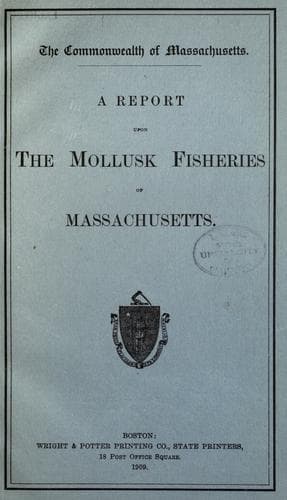
A Report upon the Mollusk Fisheries of MassachusettsMassachusetts. Commissioners on Fisheries and Game
Science
A Report upon the Mollusk Fisheries of Massachusetts
Massachusetts. Commissioners on Fisheries and Game
Shellfish fisheries -- Massachusetts
Number of men, 5
Capital invested, $15
Production, 1907:--
Bushels, 400
Value, $320
Total area (acres):--
Sand, 400
Mud, -
Gravel, -
Mussels and eel grass, -
Total, 400
Productive area (acres):--
Good clamming, 3
Scattering clams, 3
Barren area possibly productive (acres), 200
Waste barren area (acres), 194
Possible normal production, $21,000
_Chatham._
Chatham can no longer be considered as the best clam-producing town of
southern Massachusetts. In 1879 Chatham produced a greater quantity
of soft clams than all the rest of the Cape; to-day all has changed,
and the annual output is far less than several other towns of the Cape
district.
The town of Chatham is situated in the southeastern portion of Cape
Cod, and includes that part which is commonly called the "elbow" of the
Cape. It is surrounded on the north, east and south sides by the ocean,
while on the south the peninsula known as Monomoy Island extends for 9
miles.
The clamming territory of Chatham is situated in Stage harbor, Pleasant
Bay and at Monomoy Point.
In Stage harbor clams are found along the sides of the Mill Pond,
comprising possibly an acre, and in the eastern end of the harbor
toward the dike, where about 3 acres of flats are thickly set.
An extended area of sand flats are found in Pleasant Bay. But small
parts of this area furnish good clamming, and the Common Flats on the
inside of Monomoy Island, where once there were acres of good clams,
now lie entirely barren except for a small patch of set just north of
Brant Island, comprising about 1/5 of an acre. Here are about 100 acres
of barren flats which only need planting to be made productive.
The commercial clam fishery, of the town is carried on at Monomoy
Point, where 5 acres of the best clamming in Massachusetts is found.
The Powder Hole flats, formed of coarse, clean sand, are thickly set
with clams of all sizes, and furnish excellent digging. A good clammer
can obtain from 5 to 6 bushels per tide from these flats.
Clams are dug at Chatham during the fishing season chiefly for bait.
Such digging lasts through the fall and winter. In the summer, clams
are dug only for food, as no cod fishing is conducted in the warm
months. From 10 to 15 men were engaged in clamming during the summer
of 1907, travelling from Chatham to Monomoy Point in power or sail
dories. Practically all the clams dug came from the Powder Hole flats
at Monomoy Point. These were purchased at Chatham wharf by fish firms
at the price of $2 per barrel.
Public-domain text, read in full here on John Shaqi.
Reviews
Reviews
No reviews yet
Be the first to share your thoughts on this work.
Elsewhere in the archive
Join the Discussion
Join the discussion
Sign in to leave a comment or review.
Sign InorCreate an account