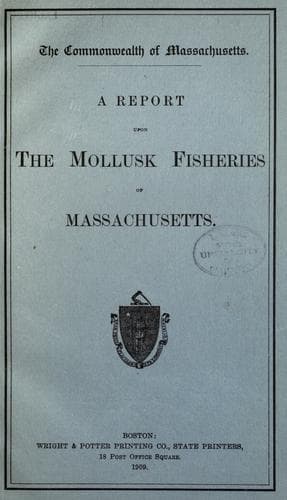
A Report upon the Mollusk Fisheries of MassachusettsMassachusetts. Commissioners on Fisheries and Game
Science
A Report upon the Mollusk Fisheries of Massachusetts
Massachusetts. Commissioners on Fisheries and Game
Shellfish fisheries -- Massachusetts
The clam industry at Fairhaven suffers from the unsanitary condition
of the flats, though in a lesser degree than at New Bedford. The
finest clam grounds of this town lie in the proscribed district of the
Acushnet River, and handling or eating shellfish from this area is a
positive menace to the public health.
A strip of gravel-mud about 100 feet in average width fringes the
shores of Priest's Cove, and this strip furnishes at present the best
digging. Scattered patches of clams occur along the indentations of
Sconticut Neck, around West Island and along the coast of Little
Bay. No men are regularly employed in digging clams, though a rather
inefficient attempt is made at times to supply the local demand.
SUMMARY OF INDUSTRY.
Number of men, -
Capital invested, -
Production, 1907:--
Bushels, 100
Value, $100
Total area (acres):--
Sand, -
Mud, 25
Gravel, 25
Mussels and eel grass, -
Total, 50
Productive area (acres):--
Good clamming, -
Scattering clams, 25
Barren area possibly productive (acres), 25
Waste barren area (acres), -
Possible normal production, $7,500
_New Bedford._
The clam industry at New Bedford was never of any great importance,
but the unwise methods of sewage disposal of the city, whereby the
effluent enters the harbor in close proximity to the clam flats,
renders the taking of shellfish a positive menace to the public health.
The action of the State Board of Health in closing the Acushnet River
and Clark's Cove to the clam digger virtually annihilated the remnant
of the industry. Now practically all the available territory of the
city is proscribed, and no clams are allowed to be taken from this
area except for use as bait. Licenses are also required to take clams
even for bait from this proscribed territory. Three hundred and twenty
of these licenses have been issued since the passage of the act in
1904. The annual yield of clams for this purpose cannot be accurately
ascertained, but probably does not exceed 250 bushels. No important
clam industry would ever have been possible at New Bedford, under any
circumstances, but the slight possibilities which once existed have
been swept away and can never return under the present conditions,
though shellfish grown in this region could, if suitable legislation
were enacted, be transplanted to a sanitary environment, where in a
month all danger of spreading typhoid germs would be avoided.
SUMMARY OF INDUSTRY.
Public-domain text, read in full here on John Shaqi.
Reviews
Reviews
No reviews yet
Be the first to share your thoughts on this work.
Elsewhere in the archive
Join the Discussion
Join the discussion
Sign in to leave a comment or review.
Sign InorCreate an account