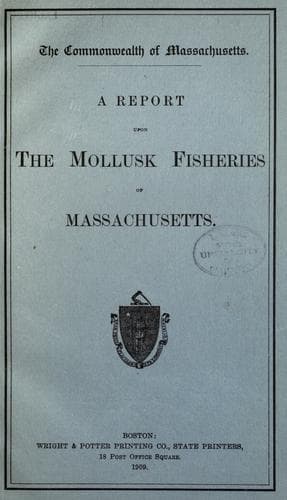
A Report upon the Mollusk Fisheries of MassachusettsMassachusetts. Commissioners on Fisheries and Game
Science
A Report upon the Mollusk Fisheries of Massachusetts
Massachusetts. Commissioners on Fisheries and Game
Shellfish fisheries -- Massachusetts
The present shellfish laws are based upon the principle of "public"
fisheries, and were made at times and at places where there was such
a superabundance that the natural increase was sufficient to meet
the market demands. Artificial cultivation was unnecessary. The
fundamental laws were made in the colonial days. Since then the demand
for shellfish as food has enormously increased, and for many years the
annual natural increase has been entirely inadequate to meet these
demands. We have outgrown the conditions which the original conception
of that law covered. Under parallel conditions it has been found
necessary to sell or lease the public lands, in order that the yield of
food may be increased by cultivation under the immediate direction and
responsibility of individual citizens, and under protection of State
and national laws. When it was learned that the yield of a cultivated
oyster bed far exceeded the natural product both in quantity and
quality, the oyster laws were so modified that an important industry
was built up, until to-day practically the entire oyster yield of
Massachusetts, Rhode Island and Connecticut is from cultivated beds,
and the total product is many times the total catch from the natural
beds in their palmiest days. To-day not only is it necessary to so
modify the oyster laws as to increase the opportunities for better
utilizing our bays and estuaries for oyster growing on a more extensive
scale than is done at present, but also for developing similar methods
of growing clams and quahaugs, and perhaps also scallops. The tidal
flats must, as well as the deeper waters, be made to produce food and
money by securing a larger yield per acre, and by the utilization of
thousands of acres which are now practically idle, but which either are
now adapted for growing shellfish or can readily be made so.
Our present shellfish laws are a heterogeneous, conflicting patchwork,
devised to meet temporary and local conditions, utterly inadequate
to-day to permit the fishermen to secure a just return for their labor,
and completely sacrificing the public interests. In many cases the
responsible tax-paying citizen cannot find a place to dig a family
supply of clams or quahaugs, neither can the industrious native
fisherman get a fair day's pay for his labor.
Public-domain text, read in full here on John Shaqi.
Reviews
Reviews
No reviews yet
Be the first to share your thoughts on this work.
Elsewhere in the archive
Join the Discussion
Join the discussion
Sign in to leave a comment or review.
Sign InorCreate an account