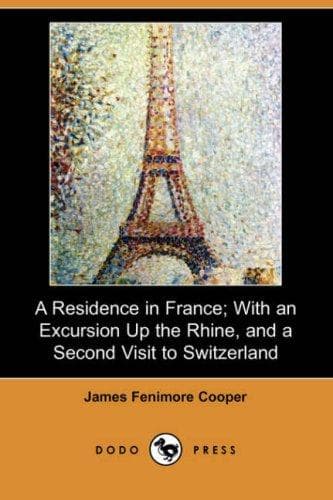
A Residence in France: With an Excursion Up the Rhine, and a Second Visit to SwitzerlandCooper, James Fenimore
History
A Residence in France: With an Excursion Up the Rhine, and a Second Visit to Switzerland
Cooper, James Fenimore
France -- Description and travel; Germany -- Description and travel; Switzerland -- Description and travel
Returning from our walk, the convent and its long existence, the nature
of the institution, its present situation, and all that poetical feeling
could do for both, were permitted to resume their influence; but, alas!
the monks were common-place, their movements and utterance wanted the
calm dignity of age and chastened habits, the building had too much of
the machinery, smell, and smoke of the kitchen; and, altogether, we
thought that the celebrated convent of St. Bernard was more picturesque
on paper than in fact. Even the buildings were utterly tasteless,
resembling a _barnish_-looking manufactory, and would be quite
abominable, but for the delightfully dreary appearance of their
material.
It is a misfortune that vice so often has the best of it in outward
appearance. Although a little disposed to question the particular
instance of taste, in substance, I am of the opinion of that religionist
who was for setting his hymns to popular airs, in order "that the devil
might not monopolize all the good music," and, under this impression, I
think it a thousand pities that a little better keeping between
appearances and substance did not exist on the Great St. Bernard.
The convent is said to have been established by a certain Bernard de
Menthon, an Augustine of Aoste, in 962, who was afterwards canonized for
his holiness. In that remote age the institution must have been
eminently useful, for posting and Macadamized roads across the Alps were
not thought of. It even does much good now, as nine-tenths who stop here
are peasants that pay nothing for their entertainment. At particular
seasons, and on certain occasions, they cross in great numbers, my guide
assuring me he had slept at the convent when there were eight hundred
guests; a story, by the way, that one of the monks confirmed. Some fair
or festival, however, led to this extraordinary migration. Formerly the
convent was rich, and able to bear the charges of entertaining so many
guests; but since the Revolution it has lost most of its property, and
has but a small fixed income. It is authorized, however, to make
periodical _quêtes_ in the surrounding country, and obtains a good deal
in that way. All who can pay, moreover, leave behind them donations of
greater or less amount, and by that means the charity is still
maintained.
As many perish annually on the mountain, and none are interred, another
dead-house stands quite near the convent for the reception of the
bodies. It is open to the air, and contained forty or fifty corpses in
every stage of decay apart from putrescency, and was a most revolting
spectacle. When the flesh disappears entirely, the bones are cast into a
small enclosure near by, in which skulls, thigh-bones, and ribs were
lying in a sort of waltz-like confusion.
Public-domain text, read in full here on John Shaqi.
Reviews
Reviews
No reviews yet
Be the first to share your thoughts on this work.
Elsewhere in the archive
Join the Discussion
Join the discussion
Sign in to leave a comment or review.
Sign InorCreate an account