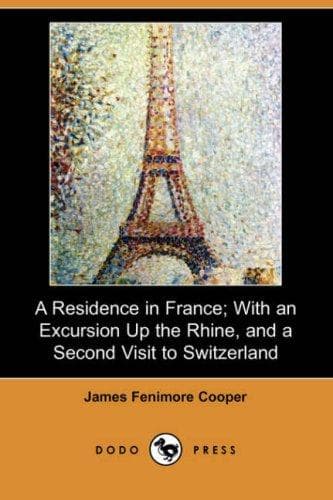
A Residence in France: With an Excursion Up the Rhine, and a Second Visit to SwitzerlandCooper, James Fenimore
History
A Residence in France: With an Excursion Up the Rhine, and a Second Visit to Switzerland
Cooper, James Fenimore
France -- Description and travel; Germany -- Description and travel; Switzerland -- Description and travel
The system is that of a confederation, which leaves each of its members
to do pretty much as it pleases, in regard to its internal affairs. The
central government is conducted by a Diet, very much as our affairs were
formerly managed by the old Congress. In this Diet, each canton has one
vote. The executive power, such as it is, is wielded by a committee or
council. Its duties do not extend much beyond being the organ of
communication between the Diet and the Cantons, the care of the treasury
(no great matter), and the reception of, and the treating with, foreign
ministers. The latter duty, however, and indeed all other acts, are
subject to a revision by the Diet.
Although the cantons themselves are only known to the confederation as
they are enrolled on its list, many of them are subdivided into local
governments that are perfectly independent of each other. Thus there are
two Unterwaldens in fact, though only one in the Diet; two Appenzells,
also; and I may add, half a dozen Grisons and Valais. In other words,
the two Unterwaldens are absolutely independent of each other, except as
they are connected through the confederation, though they unite to
choose common delegates to the Diet, in which they are known as only one
canton, and possess but one vote. The same is true of Appenzell, and
will soon, most probably, be true of Schweitz and Basle; in both of
which there are, at this moment, serious dissensions that are likely to
lead to internal separations.[44] The Grisons is more of a consolidated
canton than these examples, but it is subdivided into _leagues_, which
have a good many strong features of independence. The same is true of
Valais, where the subdivisions are termed _dizains_. The Diet does
little beyond controlling the foreign relations of the republic. It
makes peace and war, receives ambassadors, forms treaties, and enters
into alliances. It can only raise armies, however, by calling on the
cantons for their prescribed contingents. The same is true as respects
taxes. This, you will perceive, is very much like our own rejected
confederation, and has most of its evils; though external pressure, and
a trifling commerce, render them less here than they were in America. I
believe the confederation has some control over the public mails, though
I think this is done, also, _through_ the cantons. The Diet neither
coins money, nor establishes any courts, beyond its own power to decide
certain matters that may arise between the cantons themselves. In short,
the government is a very loose one, and it could not hold together in a
crisis, were it not for the jealousy of its neighbours.
[Footnote 44: Basle is now divided into what are called "Basle town" and
"Basle country;" or the city population and the rural. Before the late
changes, the former ruled the latter.]
Public-domain text, read in full here on John Shaqi.
Reviews
Reviews
No reviews yet
Be the first to share your thoughts on this work.
Elsewhere in the archive
Join the Discussion
Join the discussion
Sign in to leave a comment or review.
Sign InorCreate an account